KRK ROKIT 5 G5 Review (2026): The Yellow-Cone Monitor vs Yamaha HS5
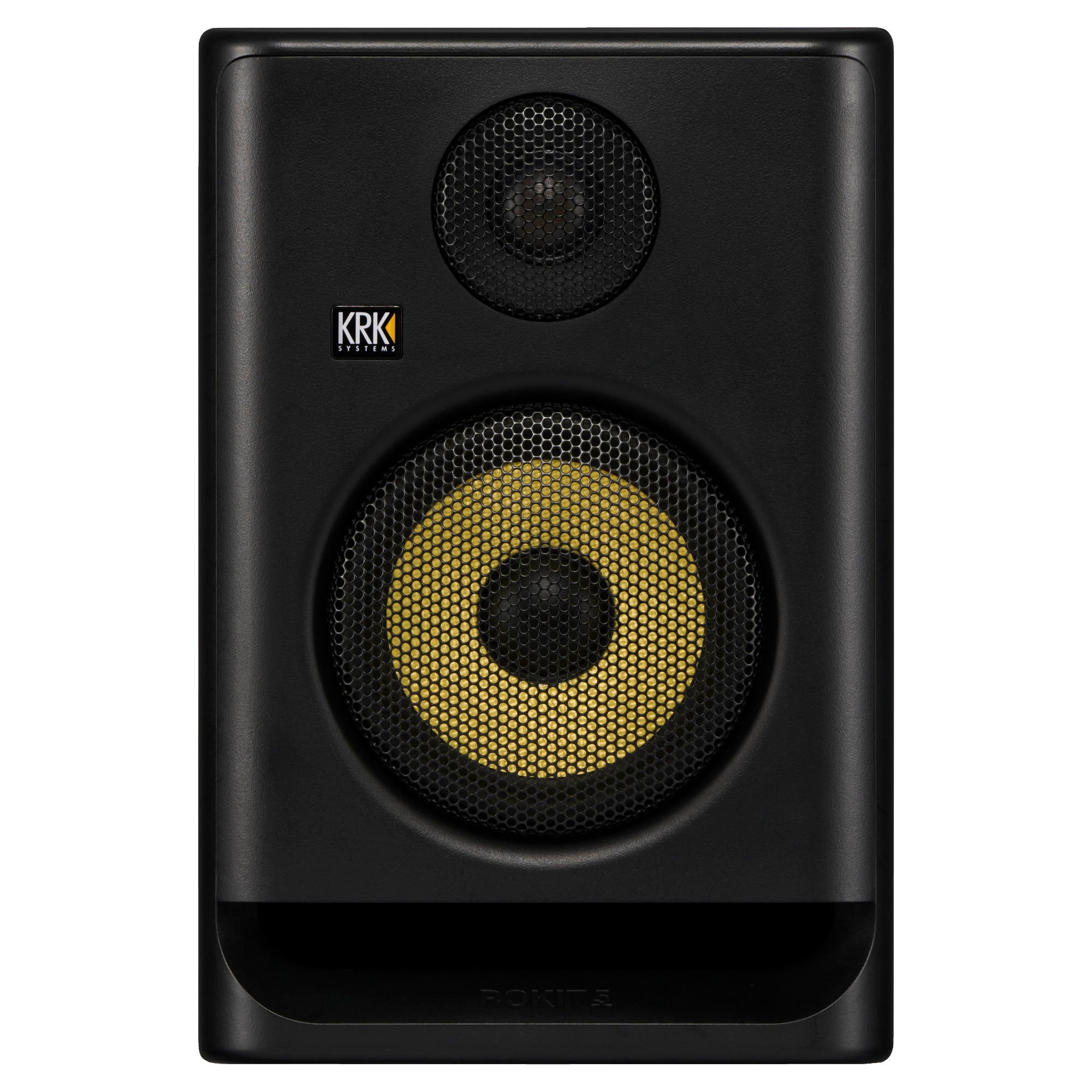
Image: KRK Systems (official product page og:image)
Next to Yamaha's white cone, there's one other speaker you'll spot in almost every hip-hop studio tour: the one with the yellow cone. That's KRK's ROKIT series.
The current generation is the ROKIT 5 Generation Five (G5, model RP5G5) — a 5-inch Kevlar-woofer monitor that pairs classic ROKIT low-end attitude with DSP voicing and smartphone-app room tuning. It sells for around $199 per speaker (about $398 per pair) at KRK's official store (checked July 2026).
In this guide, the Beat Lab editorial team covers why the yellow cone became the beatmaker's default, the question everyone asks — Yamaha HS5 or ROKIT 5? — and what the three Voicing Modes and KRK App correction are actually worth.
What is the KRK ROKIT? How the yellow cone became the hip-hop standard
KRK Systems has built studio monitors for over 35 years (the brand is now part of the Gibson family). The ROKIT line spread through home studios worldwide on two strengths: an accessible price, and a character that lets the low end genuinely thump. For hip-hop, R&B, and EDM producers, the yellow woofer became part of the visual language of a beatmaking room.
If Yamaha's HS series is the "flat reference that hides nothing," the ROKIT is the monitor that also shows you the energy of the music you're making. You can feel an 808 glide and the pressure of a kick while you build the beat — and with Generation Five's flat Mix mode on board, the same pair can switch into judgment mode when it's time to mix.
ROKIT 5 G5 specs at a glance
| Type | Bi-amplified 2-way bass-reflex (front-ported) powered studio monitor |
|---|---|
| Drivers | LF: 5" woven Kevlar (yellow) cone woofer / HF: 1" silk dome tweeter |
| Frequency range | 43Hz–40kHz (+3/-10dB) / 54Hz–30kHz (±3dB) |
| Amplification | Class D, 55W total (LF: 35W + HF: 20W) / 130W peak dynamic, max SPL 104dB |
| DSP | 3 Voicing Modes (Mix / Create / Focus) + 25 boundary & tuning EQ combinations (KRK Audio Tools app) |
| Input | Balanced XLR / 1/4" TRS combo x1 |
| Size & weight | 191 x 288 x 242mm / 4.95kg (each) |
| Included | Isolation foam pads, swappable magnetic faceplates (grille / no grille) |
| Price (reference) | around $199 per speaker / $398 per pair |
Specs from KRK's official site; price checked July 21, 2026 at krkmusic.com and authorized dealers. Prices vary with sales and region.
A quietly great detail: isolation pads and protective grilles are in the box. You don't need to buy decoupling accessories separately to get a proper desktop setup on day one. Like the HS5, it's normally sold as a single unit (pair bundles exist) — buy two for stereo.
The sound: bass weight vs the HS5's flat restraint
The ROKIT 5 and the HS5 are the two default 5-inch monitors — and their spec sheets reveal two very different personalities.
🔊 The ROKIT digs deeper: real weight down to 43Hz
At the -10dB point, the HS5 reaches 54Hz while the ROKIT 5 G5 reaches 43Hz. For a 5-inch cabinet that's a clearly deeper reach, which means the fundamental region of an 808 actually registers on the speakers. For bass-driven genres, the ROKIT is simply more fun — and more informative — to produce on.
📏 The HS5 stays the stricter flat reference
The HS5 deliberately doesn't push its low end, which keeps small rooms from saturating with bass and makes it a plain but dependable ruler for mix decisions. If flaw-finding is your top priority, that restraint still wins — see our full HS5 review.
📱 Correction philosophy: analog switches vs DSP + app
The HS5 offers two analog rear switches (ROOM CONTROL / HIGH TRIM). The ROKIT 5 G5 answers with 25 DSP boundary and tuning EQ combinations, guided by the free KRK Audio Tools app, which analyzes your room through your phone's mic and recommends settings. If you've never treated or measured a room before, this guided workflow is a genuinely useful safety net.
Cheat sheet: HS5 vs ROKIT 5 G5 character chart
We condensed the choice into one chart. Bookmark it and come back whenever you're picking a 5-inch monitor.
| Yamaha HS5 | KRK ROKIT 5 G5 | |
|---|---|---|
| Character | Uncolored, flat reference | Bass weight + production energy |
| Low end (-10dB) | 54Hz | 43Hz |
| Woofer | 5" white cone | 5" woven Kevlar yellow cone |
| Correction | Analog switches (ROOM CONTROL / HIGH TRIM) | 25 DSP EQ combos + app-guided measurement |
| Voicing modes | None (always flat) | Mix / Create / Focus |
| Port position | Rear (sensitive to wall placement) | Front (more forgiving near walls) |
| In the box | Power cable etc. only | Isolation pads + swappable grilles |
| Price (reference) | around $200 each / $400 per pair | around $199 each / $398 per pair |
| Best for | Flat reference, first monitor, strict mixing | Bass-heavy genres, app-guided setup |
Chart by the Beat Lab editorial team. Specs from each maker's official site; prices checked July 2026 (US reference pricing — in some regions, e.g. Japan, the ROKIT 5 G5 street price runs roughly double the HS5's, so check local stores). Frequency figures unified at -10dB. Amp power ratings use different measurement standards, so we don't compare them directly. If you share or quote this chart, please link back to this page.
- Pick the ROKIT 5 G5 if: you mainly make hip-hop, trap, or EDM; you want to feel 808 weight while producing; you want app-guided room tuning; or your desk sits close to a wall (front port).
- Pick the HS5 if: an uncolored reference for final mix decisions is your top priority, or you'd rather put the savings toward monitor headphones or an audio interface.
- Extremely tight desk? If you're on a sub-120cm desk with speakers sitting directly on it, also consider the ultra-compact, DSP-corrected iLoud Micro Monitor.
Are three Voicing Modes really "three monitors in one"?
The headline feature of Generation Five is the trio of DSP voicings.
- Mix: flat frequency and phase response — the mode for mixing, mastering, and critical decisions.
- Create: a flattering, inspirational balance for writing, producing, and casual listening.
- Focus: emphasizes the midrange band where vocals and most instruments live, for critical mid analysis.
The workflow we recommend: build beats in Create, then switch to Mix before you commit to balance decisions. Being able to change your monitor's personality between "making time" and "judging time" is worth real money in a home studio that only fits one pair. The flip side: finishing a mix while still in Create is how low-end mistakes happen. Always verify in Mix at moderate volume, and run your bounces through our free loudness / LUFS checker.
Official KRK channel demo of the ROKIT Generation Five
Placement: the front port and included pads love wall-adjacent desks
The fundamentals match any monitor (tweeters at ear height, equilateral triangle, don't couple to the desk), but three points are ROKIT-specific.
- Use the front port to your advantage: with the bass-reflex port on the front baffle, low end stays better behaved near a wall than rear-ported designs. Still, keep 20cm or more of clearance if you can.
- Angle up with the included pads: the foam wedges support flat or tilted placement — on a desk, tilt the speakers so the tweeters aim at your ears.
- Measure with the app, then cut — don't boost: run the KRK Audio Tools analyzer, and use the recommended EQ to trim the build-ups first. Subtractive correction is the golden rule of monitor tuning.
Honest downsides — and how to work around them
⚠️ Regional pricing can sting
At US reference pricing the ROKIT 5 G5 and HS5 sit neck and neck, but in some markets the gap is wide — in Japan the ROKIT pair currently costs nearly twice the HS5 pair (checked July 2026). Decide whether the DSP, app tuning, and included accessories justify the difference where you live.
⚠️ The "feel-good" sound can hijack your judgment
Create mode's flattering balance is the ROKIT's charm, but finalizing a mix in it leads to over- or under-cooked low end. Judge in Mix mode, at moderate volume. For sub-bass verification, pair the speakers with monitor headphones.
⚠️ You'll effectively need an audio interface
The single balanced XLR/TRS combo input isn't designed to hang off a laptop headphone jack. If you don't own one yet, budget for an audio interface as part of the purchase.
FAQ
Q1. Should I buy the KRK ROKIT 5 G5 or the Yamaha HS5?
A. Decide by bass weight and correction features. If you make hip-hop, trap, or EDM and want to feel 808s and kicks while you produce, the ROKIT 5 G5 is the better fit — it reaches down to 43Hz (-10dB) and adds DSP room tuning with app guidance. If you want an uncolored, flat reference for mix decisions on a tighter budget, the HS5 remains the classic choice.
Q2. Is the ROKIT 5 G5 good for hip-hop production?
A. Yes. Low-end extension to 43Hz (-10dB) and the production-oriented Create voicing make it easy to judge 808 and kick weight on speakers alone. Just make your final mix decisions in the flat Mix mode.
Q3. What changed from ROKIT G4 to G5?
A. Generation Five adds a newly designed 1-inch silk dome tweeter, three DSP Voicing Modes (Mix, Create, Focus), 25 boundary and tuning EQ combinations configurable with the free KRK Audio Tools app, plus included isolation foam pads and swappable magnetic faceplates (grille or no grille).
Q4. Is the ROKIT 5 G5 sold as a single speaker or a pair?
A. It is normally sold as a single powered monitor (around $199 each at KRK's official store, checked July 2026), with pair bundles offered by many dealers. You need two for stereo, and each speaker has its own power connection.
Verdict: a monitor you buy for the making, not just the checking
The ROKIT 5 G5 isn't an ascetic measuring stick like the HS5. It sells you the whole environment: low-end weight you can feel, three switchable voices, and app-guided room correction out of the box.
If most of your hours are spent building beats — and you want the 808s hitting you in the chest while you do — the yellow cone has earned its place on your desk. If all you want is the fastest route to a flat mixing reference, go read our HS5 review. Choose by how you actually spend your studio time.