beyerdynamic DT 770 PRO Review (2026): 80 vs 250 Ohm — Which to Buy?
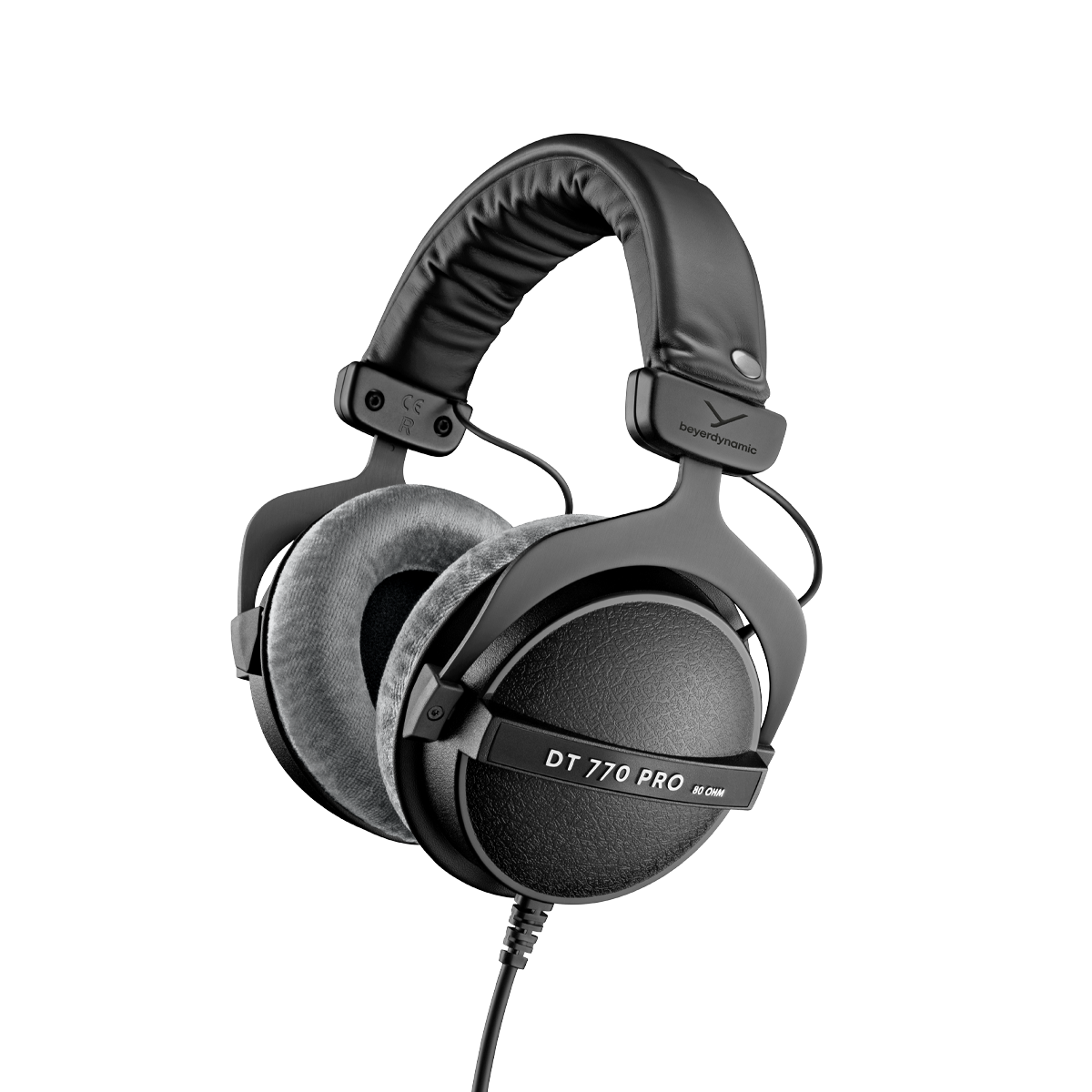
Image: beyerdynamic official site
"My ears hurt after two hours of mixing" — search that complaint and one answer keeps coming back: the beyerdynamic DT 770 PRO. Its velour earpads are the stuff of "you forget you're wearing them" reviews, and it has quietly become the default headphone for producers who work in multi-hour stretches.
Then comes the first hurdle at checkout: the same DT 770 PRO exists in 32, 80 and 250 ohm versions, and the internet is full of conflicting advice — "250 ohm sounds better," "80 is all you need." For a first serious pair of studio headphones, that's an intimidating menu.
Here's the short version: the choice is decided by the gear you plug into, almost mechanically. USB audio interface? 80 ohm. Dedicated headphone amp or high-output pro gear? 250 ohm. Phone or laptop jack? 32 ohm. Based on beyerdynamic's official information and street prices as of July 2026, this review walks through the DT 770 PRO with a one-minute impedance cheat sheet included.
DT 770 PRO specs at a glance
First, the official numbers. A design that launched in 1985 and still sits in studios worldwide tends to have specs that explain why.
| Type | Closed-back dynamic, circumaural (over-ear), wired |
|---|---|
| Frequency response | 5–35,000 Hz |
| Impedance | 32 / 80 / 250 ohm versions (pick by use case) |
| Nominal SPL | 96 dB |
| Weight | 270 g (without cable) |
| Cable | Single-sided, fixed (80 ohm version: straight cable, 3.5 mm mini-jack + 6.35 mm adapter) |
| Ear pads | Velour, replaceable (official spares: EDT 770 V / EDT 770 VB) |
| Headband | Soft-padded; approx. 3.5–5.5 N clamping force ("firm fit for professional use") |
| Build | Handmade in Germany, every part replaceable |
| Price guide (80 ohm) | Around $144–$179 US street / €159 list (checked July 2026) |
*Specs from beyerdynamic's official sites (international site and beyerdynamic.co.jp, run by Japanese distributor Media Integration). Driver size is not listed in the official spec sheet. Prices from retailer listings checked July 21, 2026 and subject to change.
The headline figure is the 5–35,000 Hz frequency response. It reaches well below the limit of human hearing, which means the lowest octave of an 808 or the body of a kick — the stuff most speakers can't resolve — stays visible. The flip side is a modest 96 dB sensitivity, and that's exactly why the impedance choice matters.
Verdict first: 80 or 250 ohm is decided by your gear (cheat sheet)
beyerdynamic officially labels the three versions 32 ohms: Mobile Devices, 80 ohms: Universal Studio and 250 ohms: Professional Devices. In other words, you choose by output power, not by taste. Find your setup in the table below and the decision takes about a minute.
| What you plug into | Pick | Why |
|---|---|---|
| Phone or tablet, direct | 32 ohm | Official "Mobile Devices" tier; reaches volume on weak outputs |
| Laptop headphone jack, direct | 32 ohm | Built-in jacks are low-powered; 80 ohm and up may fall flat |
| USB audio interface (Scarlett 2i2 class and up) | 80 ohm | Official "Universal Studio" tier — the home-production standard; any normal interface headphone out drives it fine |
| Dedicated headphone amp / high-end interface / studio gear | 250 ohm | Official "Professional Devices" tier; shows its best with real output power behind it |
| Not sure / mixed setups | 80 ohm | If an interface is anywhere in your chain, 80 ohm is the safe default |
*Impedance tiers per beyerdynamic's official selection guide (checked July 2026).
Headphone outputs vary a lot between interfaces, by the way. If you're still assembling your setup, "how to choose an audio interface" covers what to look for on the output side.
Side note: mostly on a phone? Look at the PRO X series
For people whose day splits between an interface at the desk and a phone everywhere else, beyerdynamic makes the DT 700 PRO X / DT 770 PRO X (48 ohm) with the newer STELLAR.45 driver: one impedance that runs well on almost anything, plus detachable mini-XLR cables. If you want the classic DT 770 PRO sound the studios standardized on, choose from the three classic versions; if your gear changes hourly, the PRO X line is the tidier answer.
The main event: comfort you stop noticing
Why does the DT 770 PRO keep winning the "long session" category? The answer is everything that touches your head.
Velour earpads: breathable and soft on the skin
Where most monitor headphones use pleather, the DT 770 PRO uses breathable velour earpads. They stay cool through summer sessions, sit gently over glasses, and don't flake apart with age the way pleather does.
Soft-padded headband, 270 g
The rugged headband carries a soft pad, and at 270 g (without cable) the weight load stays low. Clamping force is a professional-grade 3.5–5.5 N — it stays put when you move — yet the full over-ear fit and velour pads keep it from reading as pressure.
Strong isolation makes it a tracking headphone too
As a closed-back design it isolates well in both directions, which makes it a safe pick for monitoring vocal and rap takes: the click and beat stay out of the mic. If you want one comfortable pair that also covers recording sessions, this is exactly that pair.
Sound: neutral, precise, and deep into the lows
beyerdynamic pitches the DT 770 PRO as a benchmark, and its tuning is honest-neutral. The low end, reaching down toward 5 Hz, is the party trick: sub-bass movement stays defined instead of smearing, so 808 pitch and kick/bass masking are easy calls to make.
The highs are analytical — lip noise, sibilance and reverb tails are all fully on display. That makes it a superb fault-finder for mixing, though raw, unprocessed takes can sound less flattering than you'd like. That's a feature, not a bug, in a monitor headphone. If you finish mixes on headphones alone, run the bounce through the free dynamics checker (loudness / LUFS) afterward for an objective second opinion.
How does it compare to the ATH-M50x and MDR-7506?
The two headphones people cross-shop against the DT 770 PRO are the audio-technica ATH-M50x and the Sony MDR-7506. The one-line summary: versatile (M50x), reference (MDR-7506), comfortable (DT 770 PRO).
- ATH-M50x (around $144–$169 street, July 2026): 38 ohms and highly efficient — runs from a phone — with three detachable cables included. The pick if one pair must cover producing, DJing and listening. Full review: "ATH-M50x review."
- MDR-7506 (around $99 street, July 2026): the uncolored flat reference and the cheapest of the three. The pick if fault-finding precision per dollar is the priority.
- DT 770 PRO (around $144–$179 street, July 2026): comfort and isolation in a class of their own. The pick if headphones stay on your head all day and double for tracking. Just don't buy the 80/250 ohm versions for phone-first use — this is the pair that lives on your desk.
We compared all three across mixing accuracy, listening-double duty, long-session comfort and budget in "ATH-M50x vs MDR-7506 vs DT 770 PRO: Which to Buy? (2026 Comparison)" — start there if you're still choosing between models. A comparison including Japan's studio standard MDR-CD900ST is in "Monitor Headphones Compared."
Handmade in Germany, every part replaceable = a ten-year headphone
The DT 770 PRO is still handcrafted at beyerdynamic's own factory in Heilbronn, and every component used is replaceable — a fundamentally different philosophy from "replace it when it breaks."
- Ear pads: official velour spares — EDT 770 V (silver grey) and EDT 770 VB (black, around €21 each direct) — restore factory comfort for the price of a plugin sale.
- Headband, cable, drivers, housing: all officially available as spare parts, with repair support through authorized channels.
At around $144–$179 it's the most expensive of the big three, but amortized over a decade of pad swaps it can quietly become the cheapest per year. If you're the type who wants one long-term workhorse rather than a rotation of disposables, the build philosophy alone is a reason to buy.
The honest downsides
Classic status doesn't mean flawless. A few things to know before checkout:
- No folding, bulky to carry: the earcups don't fold, and a carry bag or hardcase is sold separately. This is a desk headphone.
- Fixed cable: single-sided and tangle-resistant, but not detachable. A break means a parts repair (the PRO X series has detachable cables if that's a dealbreaker).
- Not phone-friendly (80/250 ohm): for portable-first use, get the 32 ohm version — or honestly, the more efficient ATH-M50x.
- Firm professional clamp: at 3.5–5.5 N it grips more than a casual hi-fi headphone; the velour pads keep it comfortable, but a loose fit this is not.
Frequently asked questions
Q1. Should I buy the 80 ohm or the 250 ohm version?
Decide by the gear you plug into — that is how beyerdynamic itself frames the choice. For a typical production setup with a USB audio interface (Scarlett 2i2 class and up), the 80 ohm version — officially labeled "Universal Studio" — is the standard pick. If you run a dedicated headphone amp or high-output professional gear, the 250 ohm version ("Professional Devices") is the candidate. When in doubt, the 80 ohm version is the safe choice.
Q2. Can I use it straight from a phone or laptop?
The 80 and 250 ohm versions assume an audio interface or headphone amp; straight from a phone they won't reach their full volume or character. If you mostly plug into portable devices, consider the 32 ohm version — officially positioned for mobile devices — or the newer 48 ohm DT 700 PRO X / DT 770 PRO X, which are designed to run well on almost anything.
Q3. Is the cable detachable or replaceable?
The single-sided cable is fixed, not tool-free detachable. However, the DT 770 PRO is handmade in Germany with every component replaceable, and spare parts including cables are officially available, so a damaged cable means a repair, not a new purchase. If a detachable cable is a must, the PRO X series with its mini-XLR cables is the alternative.
Q4. Can I replace the ear pads when they wear out?
Yes. Official velour replacement pads — EDT 770 V (silver grey) and EDT 770 VB (black) — are widely available and swap on without tools. Replacing pads and headband padding over the years is exactly how one DT 770 PRO ends up serving for a decade or more.
Summary: if you work long sessions, it earns its price
For anyone who wears headphones for hours at a stretch, the beyerdynamic DT 770 PRO remains one of the best purchases in monitoring: velour-pad comfort, a 5–35,000 Hz reach into the sub-bass, isolation good enough for tracking, and a handmade, fully repairable German build. At around $144–$179 street / €159 list (July 2026), the math over a ten-year service life is comfortably in its favor.
And the buying decision stays simple: interface → 80 ohm, headphone amp → 250 ohm, portable-first → 32 ohm (or PRO X). Check the cheat sheet against your desk, then start the long relationship.