Arturia MiniLab 3 Review (2026): The Best Software Bundle on a Mini MIDI Keyboard?
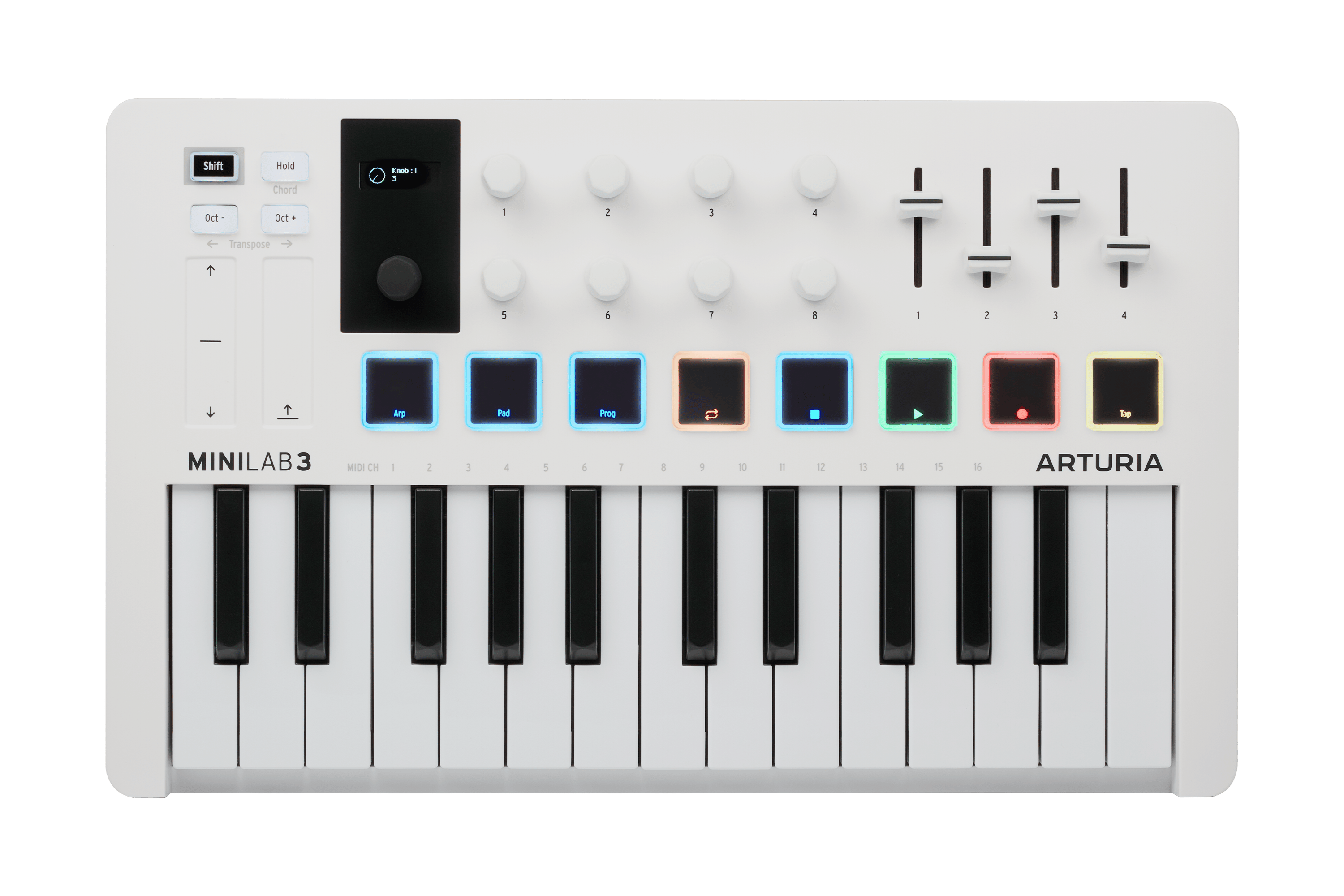
Image: Arturia (official product page)
"Okay, the MPK Mini is the default. But everyone keeps saying the MiniLab 3's software bundle is ridiculous — is it?"
The two names that dominate every "first MIDI keyboard" conversation are the Akai MPK Mini MK3 and Arturia's MiniLab 3 — and the biggest reason the MiniLab keeps gaining ground is a software bundle that arguably rivals the hardware's own price. It starts with Analog Lab Intro (around 500 synth and keyboard presets) and keeps going: Ableton Live Lite, your choice of one NI Komplete 15 Select bundle, Loopcloud, Melodics (checked July 2026).
Short version of this review: if you write from chords, melodies, and sound-browsing — and you care about key feel and hands-on faders — the MiniLab 3 is one of the best buys in the entry class. If finger drumming is your whole workflow, the MPK Mini MK3 may still fit better.
Below we cover the slim keybed, pads, and faders in practice, what the bundled software is actually worth, and a detailed MPK Mini MK3 vs. MiniLab 3 comparison table. Leaning toward full-size keys instead? Start with our 49-key MIDI keyboard comparison.
What the MiniLab 3 is: a controller designed around its sounds
The MiniLab 3 packs 25 slim velocity-sensitive keys, 8 RGB-backlit pads, 8 encoders, and 4 faders into a USB-C bus-powered controller (356 × 219 × 54 mm, 1.0 kg) — laptop-friendly, backpack-ready, and unusually well equipped for a mini board, with faders and a small display on deck.
Arturia is the French company behind V Collection, the software recreations of classic synths from Minimoog-style monos to CS-80-style polys. Analog Lab is the browser that puts that whole sound heritage in one plugin, and the MiniLab 3 is essentially designed as the hardware front end for it: turn the clickable browser knob, watch the display, pick a preset, and the encoders are already mapped to the right parameters. That out-of-the-box integration is hard for generic controllers to imitate.
It's also Arturia's "eco-designed" controller — made with at least 50% recycled plastics — and ships with a 5-year warranty, unusually long for an entry-level board.
Spec sheet at a glance (checked July 2026)
| Keys | 25 velocity-sensitive slim keys (widely praised key feel) |
|---|---|
| Pads | 8 RGB pads, velocity and pressure sensitive (2 banks = 16 assignments); can double as DAW transport control |
| Knobs / faders | 8 multi-function encoders + 4 multi-function faders (pre-mapped, assignable) |
| Other controls | Pitch-bend and modulation touch strips, mini display with clickable browser knob, arpeggiator, chord mode, hold, octave shift and semitone transpose |
| Connectivity | USB-C (bus-powered, class-compliant, iPad support), MIDI out (5-pin DIN), pedal input (sustain / expression / footswitch) |
| Size / weight | 356 × 219 × 54 mm / 1.0 kg (2.2 lb) |
| Bundled software | Analog Lab Intro, Ableton Live Lite, NI Komplete 15 Select (choose Beats, Band, or Electronic), Loopcloud 2-month subscription + sample packs, Melodics lessons, MIDI Control Center |
| Colors | Black and White, plus Aquamarine / Rose Quartz special editions |
| Extras | Eco-design with 50%+ recycled plastics, 5-year warranty |
| Price (reference) | $149 list on Arturia's store; street prices vary by region and color |
Specs per Arturia's official site; list price per Arturia's online store, checked July 21, 2026. Prices fluctuate — always confirm on the store page.
How it performs for beatmaking
🎹 The slim keybed: a class above at this price
The keys are what reviewers consistently single out. Slightly wider than typical mini keys, the slim keybed tracks velocity smoothly and feels genuinely playable — chord work, melody sketching, even light performance parts. Among sub-$150 boards, the more you care about actually playing, the more the MiniLab 3 rewards you.
Pitch bend and modulation are capacitive touch strips rather than wheels. Opinions split, but they save space and respond from wherever your finger lands — many players end up finding them faster for experimentation than wheels.
🥁 The 8 RGB pads: hit them, or run your DAW with them
The pads sense both velocity and pressure, with two banks giving 16 assignments — enough for a core kit plus one-shots. There's no Note Repeat, so if one-finger trap hi-hat rolls are your bread and butter, the MPK Mini keeps that edge. In exchange, the MiniLab's pads can double as DAW transport controls (play, record, and more), so the browse-play-record loop happens entirely on the hardware.
🎛️ 8 encoders + 4 faders + display: mixing moves on a mini board
Four physical faders at this price point is a genuine differentiator. Riding levels and sends with your fingers is a different experience from mouse-dragging. The 8 encoders come pre-mapped for Analog Lab and major DAWs — Ableton Live, Logic Pro, Cubase, FL Studio, Bitwig and more — so hands-on control works on day one with zero mapping, and the mini display shows the parameter and value as you tweak. MCU/HUI support covers virtually everything else, and NKS compatibility ties it into Native Instruments' ecosystem.
Beyond the arpeggiator, Chord mode plays rich chords from single keys — a real assist if music theory isn't your strong suit. And unlike most minis, there's a proper 5-pin DIN MIDI out, so hardware synths and grooveboxes are on the menu now or later.
The software bundle: arguably worth more than the hardware
This is the MiniLab 3's strongest argument. Here's what's in the box (per Arturia's official pages, checked July 2026), organized by role:
- Analog Lab Intro — around 500 curated presets from the V Collection and Pigments libraries: vintage-style basses, lush pads, electric pianos, leads. Browse them from the hardware's display and browser knob with encoders auto-mapped. For the full story on Arturia's library, see our Analog Lab review.
- Ableton Live Lite — a genuine entry into one of the world's most popular DAWs, with a dedicated MiniLab 3 script for tight integration.
- NI Komplete 15 Select — your choice of one bundle — pick Beats, Band, or Electronic to match your style. These are Native Instruments' curated instrument/effect collections that sell as standalone products, and the MiniLab 3's NKS support ties in cleanly.
- Loopcloud (2 months) + sample packs / Melodics lessons — millions of royalty-free samples to trial, plus interactive pad and keyboard lessons.
Bottom line: one purchase gets you a DAW, 500 synth presets, an NI instrument bundle, samples, and practice material — zero additional spend to start producing. Want to expand for free afterward? Our roundup of free plugins for beatmaking is the natural next step.
▼ Arturia's official MiniLab 3 overview tutorial
MPK Mini MK3 vs. MiniLab 3: the full comparison table
The board you'll weigh it against is Akai's MPK Mini MK3. Both are 25-mini-key / 8-pad / 8-knob controllers, but their personalities differ sharply. Here's the editorial team's side-by-side, based on both manufacturers' official specs. Feel free to share or cite this table with a link to beats.coastlinkglobal.com/blog-minilab3-en.
| Item | Arturia MiniLab 3 | Akai MPK Mini MK3 |
|---|---|---|
| Character | Built around Arturia's synth-sound ecosystem | MPC-flavored, built for drum programming |
| Keys | 25 slim keys with widely praised feel | 25 mini keys (Gen-2 dynamic keybed) |
| Pads | 8 RGB pads (velocity + pressure), doubling as DAW control | 8 MPC-style pads + Note Repeat, optimized for hitting |
| Faders | 8 encoders plus 4 faders | None (8 knobs) |
| Bend/mod | Two touch strips | 4-way thumbstick |
| Display | Mini display + clickable browser knob (preset browsing) | OLED display |
| MIDI out | 5-pin DIN MIDI out for external gear | None (USB only) |
| Performance aids | Arpeggiator + Chord mode + Hold | Arpeggiator + Note Repeat / Full Level |
| Software focus | Analog Lab Intro (~500 presets) + Live Lite + Komplete 15 Select choice, and more | MPC Beats + 3 AIR instruments (beat-production oriented) |
| Size / weight | 356 × 219 × 54 mm / 1.0 kg | 318 × 181 × 44 mm / 750 g |
| Warranty | 5 years (official) | Standard manufacturer warranty |
| Price (checked July 2026) | $149 list (street varies) | Around $99 street |
| Best for | Producers who start from sounds and chords, and want mix control | Producers who start from the drums |
Specs for both units per the manufacturers' official sites, checked July 2026. Prices are reference figures only.
The decision rule is simple: do you start a track from the drums or from chords? Hip-hop and trap producers who begin with kick-snare patterns will be happier on the MPK Mini; sound explorers who write from harmony first will prefer the MiniLab 3. For the other side of this matchup, read our Akai MPK Mini MK3 review.
Honest downsides
- No sound on its own — it's a controller; a computer (or iPad) and software are required.
- No Note Repeat — automated hi-hat rolls aren't on board. Dedicated finger drummers should look at the MPK Mini MK3.
- Touch strips are a taste — if you love the resistance of physical wheels, the strips may feel abstract at first.
- Slim keys still aren't full-size — great for the class, but two-handed playing wants a bigger board (see the 49-key comparison).
- Bundle registration takes a moment — you'll create Arturia, Ableton, NI, and Loopcloud accounts. One-time chore; budget an evening.
Who should buy it — and who shouldn't
✅ Buy it if you…
- Start tracks from chords, melodies, or preset-browsing sessions
- Want a complete production starter kit (DAW + instruments) in one purchase
- Want faders for hands-on level and send control
- Love vintage-synth sounds and the Analog Lab ecosystem
- Own — or plan to own — external MIDI hardware (DIN MIDI out)
❌ Skip it if you…
- Live and breathe finger drumming and hi-hat rolls (→ MPK Mini MK3)
- Are a trained keys player who values playability first (→ see the 49-key comparison)
- Want a standalone, computer-free setup (→ consider a sampler or groovebox)
FAQ
Q1. Can I make full tracks with just the MiniLab 3?
A. The unit itself is a MIDI controller with no internal sounds, but the bundle includes Analog Lab Intro (around 500 presets), Ableton Live Lite, your choice of one NI Komplete 15 Select bundle (Beats, Band, or Electronic), a 2-month Loopcloud subscription, and Melodics lessons — so you can start producing with zero extra spend (checked July 2026).
Q2. MiniLab 3 or Akai MPK Mini MK3?
A. If you build tracks from the drums up (finger drumming), the MPK Mini's MPC pads and Note Repeat win. If you start from sounds and chords, and want better keys, faders, and a DIN MIDI out, the MiniLab 3 with Analog Lab Intro is the better fit. See the comparison table above.
Q3. What's the difference between Analog Lab Intro and the full Analog Lab?
A. Intro is a starter edition with roughly 500 curated presets drawn from Arturia's V Collection and Pigments libraries. The full Analog Lab expands the library to thousands of presets, and you can upgrade later if you need more. Intro is plenty to produce with.
Q4. Does it work with an iPad?
A. Yes — it connects over USB-C, is class-compliant, and Arturia's official specs list iPad connectivity. It's USB bus-powered, so in most setups a single cable is all you need (check your iPad's power output for your specific configuration).
Verdict: the first controller for people who start from sounds
The MiniLab 3 isn't just another entry-level mini keyboard — it's a doorway into Arturia's sound library with genuinely good keys attached. A praised slim keybed, faders and DIN MIDI out that minis rarely offer, and a software bundle that rivals the hardware's price: one box covers playing, browsing, recording, and mixing. For producers who write from chords and sounds, it's a top pick of 2026's entry class.
Finger drummers should read the MPK Mini MK3 review next; if full-size keys are calling, the 49-key MIDI keyboard comparison is the logical next stop. And once your beats are rolling, check their tempo and key with our free browser tool BPM & Key detector.