808 Studio 2 Review: The Dedicated 808 Bass Synth vs Free Samples (2026)
Plenty of beatmakers will tell you the real star of a trap or type beat isn't the melody or the drums — it's the 808 bass. Yet for such a crucial part, most producers settle for dragging in free 808 samples. That's what makes Initial Audio's 808 Studio 2 interesting: it's that rare thing, a synth designed exclusively for 808s and sub bass.
In this article, the Beat Lab editorial team reviewed the official information on Initial Audio's website as of July 21, 2026, and breaks down 808 Studio 2's features and pricing — plus a comparison of the 3 routes to an 808: free samples, 808 Studio 2, or building your own in Serum. For the mixing side (making your 808 sit with the kick), see our separate guide on how to mix 808s and bass. For which of the three routes fits you best, see our detailed 808 sound comparison (free samples vs 808 Studio 2 vs building your own).
What is 808 Studio 2? A bass synth built only for 808s
808 Studio 2 is a dedicated bass soft synth from Initial Audio, the developer known for Heat Up 3 and Sektor (VST/VST3, AU, AAX and Standalone; v2.1.2 at the time of writing). As the official site puts it — "from clean sub bass to down-and-dirty 808s, build your signature low end from scratch" — its biggest characteristic is a design narrowed down entirely to 808 and sub bass duties.
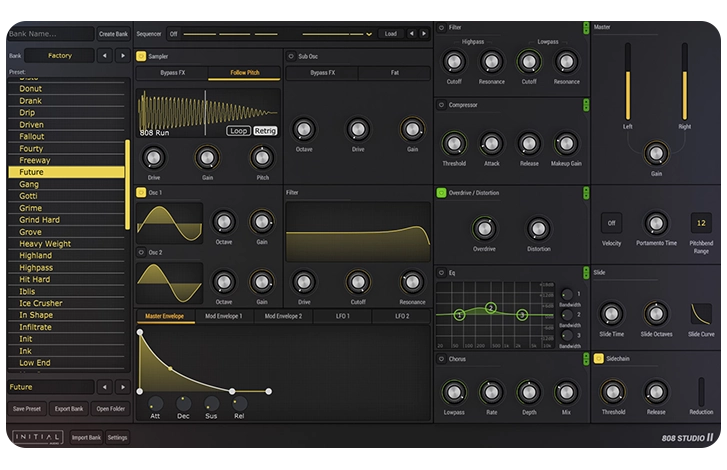
The layout is simple and 808-focused: 3 oscillators plus a dedicated sub oscillator and a sampler. With 80+ 808 presets included, you can start from a preset and only tweak what bothers you. The update from the original 808 Studio was provided free to existing users.
808 Studio 2 overview from the official Initial Audio channel
Feature review: 3 things free samples can't do
1. Tuning and glide become as easy as programming MIDI
Unlike a pre-recorded sample, 808 Studio 2 is a synth — so tuning to your song's key is just a matter of playing the right MIDI notes. Better yet, overlapping notes produces the classic trap pitch glide automatically, which is far faster than hand-drawing pitch bends on a sample and comes with zero quality loss. The filter offers keytracking too, so high and low notes stay consistent in character — a specialist-tool advantage. Not sure of your song's key? Our free BPM & key detection tool can find it in the browser.
2. Distortion you can dial in — and back out — after the fact
Harmonics (distortion) are what make an 808 audible on phone speakers, but a sample that comes pre-distorted can never be made cleaner. 808 Studio 2 has overdrive, distortion, a bitcrusher and hard/soft clipping built in, all adjustable by knob. The chorus can be applied to the highs only so the sub stays clean, and there's a 3-band EQ plus built-in sidechain ducking to make room for your kick — implementation choices clearly made with 808s in mind.
3. Layer "your" 808 with the built-in sampler
A drag-and-drop sampler lets you load your own 808 samples and layer them with the oscillators — the classic pro recipe of "sample for the attack, clean synth for the sub" inside a single plugin. Drag-and-drop modulation, a tempo-synced LFO and a real-time waveform scope round it out for moving, evolving bass design.
Cheat sheet: 3 routes to an 808 — free samples vs 808 Studio 2 vs building in Serum
There are basically three ways to get an 808. Here's our one-table summary of where each wins and loses.
| Criteria | Free 808 samples | 808 Studio 2 | Build in Serum etc. |
|---|---|---|---|
| Cost | Free | $69 list (checked July 2026) | $249 (Serum 2) no extra cost if you own it |
| Ease of use | Great — just drag in | Great — 80+ presets ready to go | Hard — design from scratch |
| Tuning | Poor — repitching degrades quality | Excellent — free via MIDI, no degradation | Excellent — free via MIDI, no degradation |
| Glide | None — hand-draw pitch bends | Excellent — just overlap notes | Good — via portamento settings |
| Distortion freedom | Poor — baked in, can't reduce | Excellent — 4 built-in types, dial in/out | Excellent — but you design the FX chain |
| Uniqueness | Poor — same sound as everyone else | Good — tweaks + sample layering | Excellent — fully original |
| Best for | Beginners finishing their first beats | Trap/type-beat producers who lead with 808s | Advanced users who enjoy sound design |
Ratings reflect the Beat Lab editorial team's summary of general tendencies. If you quote or share this chart, please link back to this page.
The conclusion is simple: if you don't want your 808s to be borrowed sounds, a dedicated tool like 808 Studio 2 is the shortest route. If you already own Serum 2 and enjoy sound design, you can get there yourself. The lack of competition in the price bracket between the two also makes this plugin's positioning easy to understand.
Price and system requirements (as of July 21, 2026)
| Item | Details |
|---|---|
| List price | $69 (official Initial Audio listing; varies with sales) |
| License | One-time perpetual license, 3 simultaneous activations, free lifetime updates |
| Formats | VST / VST3, AU, AAX, Standalone (64-bit) |
| OS | Windows 10/11, macOS 10.13+ (Apple Silicon native) |
| Free demo | Yes — fully functional with occasional noise bursts, no registration (Win/Mac) |
Checked by the editorial team on Initial Audio's official website on July 21, 2026. Prices may vary with sales and currency. See the linked store for current pricing.
The other dedicated 808 synth: how SubLab XL differs
In the small "dedicated 808 synth" category, the plugin most often compared with 808 Studio 2 is Future Audio Workshop's SubLab XL. Both are purpose-built for 808s and sub-bass, but their character differs. Where 808 Studio 2 gets you there fast with 80+ presets and four distortion types, SubLab XL pairs three sound engines — Sampler, Synth and X-Sub — with 100+ presets, a Super Oscillator, modulation and stackable FX, leaning toward deeper sculpting of the low end. Pricing is close: SubLab XL is ~$80 list (~$39 on sale, checked July 2026) against 808 Studio 2's $69.
| Criteria | 808 Studio 2 | SubLab XL |
|---|---|---|
| Price (list) | $69 | $80 (~$39 on sale) |
| Presets | 80+ | 100+ |
| Engine | 3 oscillators + dedicated sub + sampler | 3 engines (Sampler/Synth/X-Sub) + Super Oscillator |
| Strength | Fast results, preset-driven | Deep sculpting via modulation & FX |
| In common | 808-focused; free MIDI tuning/glide; add or remove distortion; fully functional demo | |
Both ship a fully functional demo on their official sites, so the safest call is to A/B the sound and UI and pick whichever fits your genre. For where SubLab XL sits across all the routes, see our guide to choosing an 808 source (free samples vs 808 Studio 2/SubLab XL vs DIY).
SubLab XL walkthrough (featured by FAW on their "Meet SubLab XL" page)

Who should buy it / who can skip it
- Trap and type-beat producers whose 808 leads the record: having glide, tuning and distortion freely adjustable every time raises both the quality and the speed of your low end
- Anyone tired of "same 808 as everyone else" syndrome: preset tweaks plus layering your own samples gets you a signature 808 fast
- Sound-design devotees can skip it: with solid synthesis fundamentals you can build 808s yourself — see our Serum 2 review if you'd rather invest in one do-everything synth
- On a zero budget? Start with our 8 recommended free plugins and upgrade once free 808s start holding you back
Once it's installed, the mixing stage — kick/808 separation, mono compatibility, saturation — decides the final result. We cover the full process in how to mix 808s and bass, and you can sanity-check your bounced mix with our free dynamics checker (LUFS).
FAQ
Q1. What's the difference between free 808 samples and 808 Studio 2?
A. A sample is a single pre-recorded sound: heavily changing its pitch, length or distortion afterwards degrades quality. 808 Studio 2 is a synth, so key-accurate tuning, glide created by overlapping notes, and the amount of built-in distortion are all freely adjustable via MIDI and parameters.
Q2. Can I try it for free?
A. Yes. Initial Audio's official site offers a fully functional Win/Mac demo with no registration required (limited by occasional noise bursts), so you can verify it works in your DAW before buying.
Q3. Do I still need it if I own Serum?
A. It's not essential. But where Serum makes you build the 808 from scratch, 808 Studio 2 ships with the 808-specific shortcuts pre-installed — a dedicated sub oscillator, 80+ 808 presets and built-in sidechain ducking. It earns its keep as a time-saver alongside a general-purpose synth.
Q4. What are the system requirements and license terms?
A. Windows 10/11 (64-bit) and macOS 10.13+ (Apple Silicon native). It runs as VST/VST3, AU, AAX and Standalone, with a perpetual license, 3 simultaneous activations and free lifetime updates per the official site (checked July 21, 2026).
Verdict
808 Studio 2 gives you back the freedom of tuning, glide and distortion on the one element that carries a type beat. It fills the gap between the convenience of free samples and the freedom of building in Serum, at a realistic $69 list price (checked July 2026). Grab the official free demo first and hear what it does to your low end.