Free 808 Samples vs 808 Studio 2/SubLab XL vs Building in Serum 2: Which 808 Source to Use? (2026)
The 808 bass is the foundation of trap, drill and type beats — and when you boil it down, there are only three ways to get one: drag in free samples, use a dedicated 808 synth (Initial Audio's 808 Studio 2 or FAW SubLab XL), or build your own in a synth like Serum 2. All three can finish a record, but the cost ranges from $0 to $249, and the effort and freedom involved are completely different. Decide your route first and the rest of your workflow falls into place.
For this comparison, the Beat Lab editorial team checked the official information from Initial Audio, Xfer Records and reFX as of July 21, 2026, and lined the three routes up by style, effort and budget. If you're already a Nexus 5 user, we also cover the "just add an expansion" fourth option. And whichever route you pick, the mix decides the final result — that side is covered separately in "how to mix 808s and bass."
Verdict first: the one-minute decision table (style x effort x budget)
If you're short on time, here's the conclusion up front.
| Your style | Your route | Cost and effort |
|---|---|---|
| Finish a track today for free / the 808 isn't your star yet | Free 808 samples | $0 |
| 808-led trap or type beats — you want control without the homework | 808 Studio 2 (dedicated 808 synth / SubLab XL is the alt) | $69 list (checked July 2026), 80+ presets ready to go |
| You enjoy sound design / want a fully original 808 | Build it in Serum 2 | $249 (free upgrade for Serum 1 owners), learning curve required |
| You already build everything in Nexus 5 | Nexus 5 expansions + a separate 808 route | Expansions $60 list each; pick the 808 from the 3 routes above |
*Prices checked July 21, 2026 on the official Initial Audio, Xfer Records and reFX websites. Sales and exchange rates cause variation.
Route 1: Free 808 samples — $0 and instant, but "borrowed" sounds have limits
This is the fastest route. 808 one-shots and kits are given away in huge numbers by sample platforms and developers, and picking a sample in the right key and dragging it in is all it takes. Free quality is genuinely usable — countless released tracks run on free 808s. If you want to build your whole setup for free first, see our 8 best free plugins roundup.
Pros
- $0 and near-zero learning curve: load, drag, done. Your first ten beats need nothing more
- The sound arrives finished: processed samples already carry weight and character out of the box
Cons
- Repitching degrades the sound: an 808 is a pitched instrument living in the sub range; stretch a sample far from its root and it falls apart (check your song's key with our free BPM & key detection tool)
- Glides are painful: the classic trap pitch glide has to be hand-drawn as pitch bends
- Distortion is baked in: a pre-distorted sample can never be made cleaner
- Everyone has the same sounds: famous free 808s are used worldwide, which makes standing out harder
The weakness of the free route isn't quality — it's that nothing can be adjusted after the fact. When that starts to bother you, the next two routes exist precisely for that reason.
Route 2: 808 Studio 2 — $69 buys you the freedom to adjust
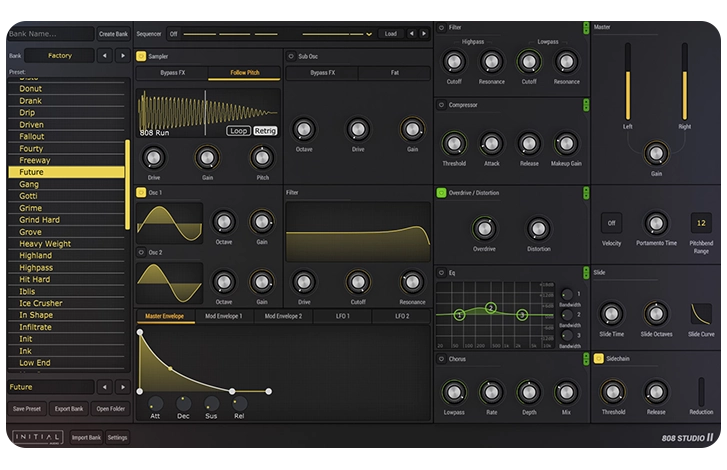
Initial Audio's 808 Studio 2 is that rare thing: a synth designed exclusively for 808s and sub bass ($69 list, checked July 2026). The layout — 3 oscillators, a dedicated sub oscillator and a sampler — ships with 80+ 808 presets, and it solves exactly the three weaknesses of the free route:
- Tuning: it's a synth, so playing the right MIDI notes puts you in key with zero quality loss
- Glide: overlap two notes and you get the classic trap pitch glide automatically
- Distortion: overdrive, distortion, a bitcrusher and clipping are built in — dial the amount in or out by knob
On top of that, a drag-and-drop sampler lets you layer your own samples with the oscillators, and there's built-in sidechain ducking to make room for your kick — the pro recipe of "sample for the attack, clean synth for the sub" inside one plugin. A fully functional free demo (occasional noise bursts, no registration) is available on the official site, so you can try before buying. Full details in our 808 Studio 2 review.
808 Studio 2 overview from the official Initial Audio channel
The honest downsides
- It only does bass: no leads, no pads. If you want one synth for everything, this isn't it
- $69 up front: if free samples aren't limiting you yet, there's no rush to buy
The other staple on this same route: SubLab XL
The other household name in dedicated 808 plugins is Future Audio Workshop's SubLab XL (~$80 list, ~$39 on sale, checked July 2026). It pairs three sound engines — Sampler, Synth and X-Sub — with 100+ presets, a Super Oscillator, modulation and stackable FX, so it leans toward deep sound-design of the low end. Both are 808-focused, but where 808 Studio 2 gets you there fast with 80+ presets and four distortion types, SubLab XL is built for more elaborate sculpting — their strengths differ. Both ship a fully functional demo, so A/B the sound and UI and pick whichever fits your genre.
SubLab XL walkthrough (featured by FAW on their "Meet SubLab XL" page)

Route 3: Build it in Serum 2 — $249 for a fully original 808
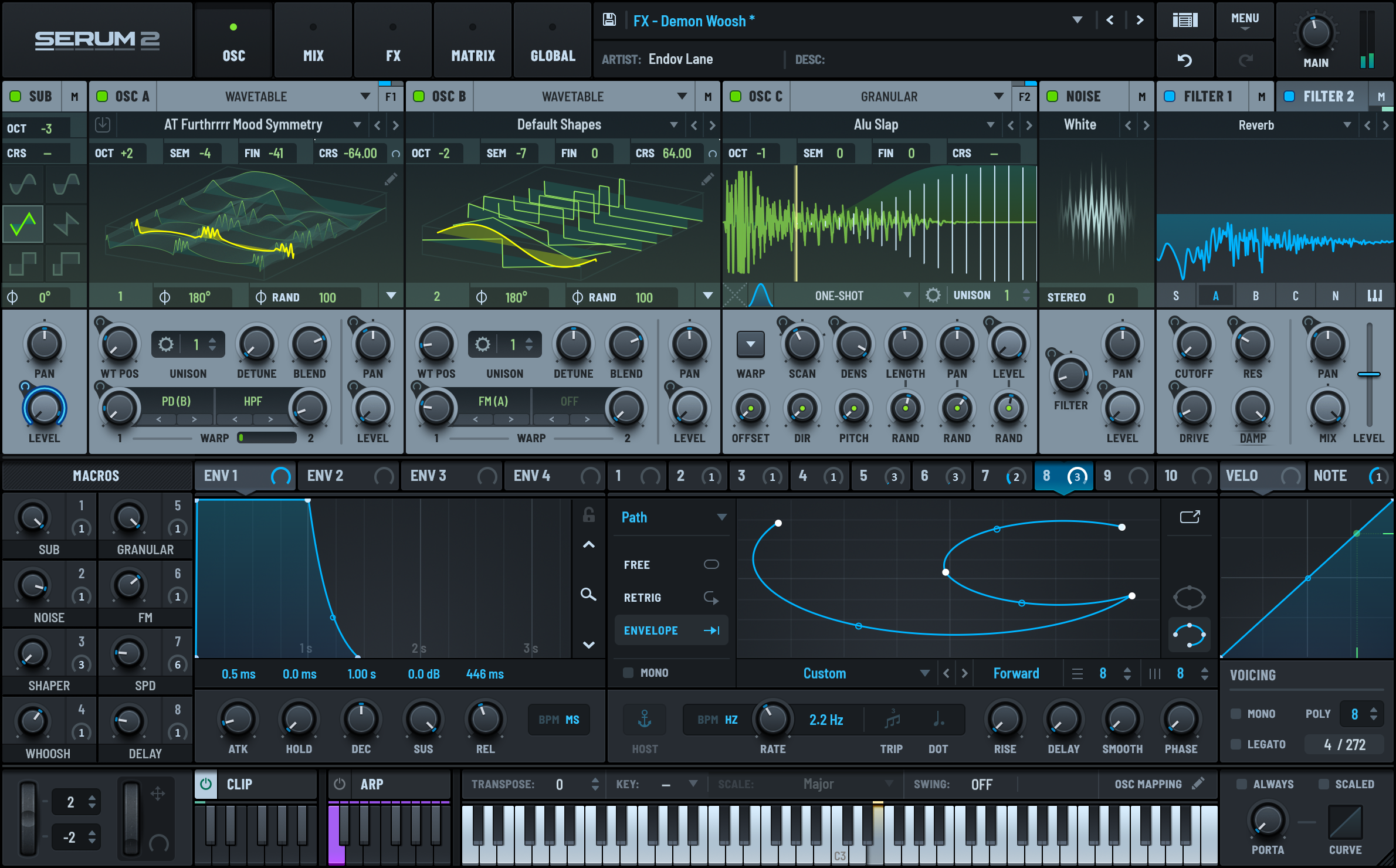
With a general-purpose synth like Xfer Serum 2, you can build an 808 from scratch: a sine (plus triangle) oscillator, a pitch envelope for the attack knock, saturation for harmonics, portamento for the glide. Because you decide the waveform, envelopes and distortion yourself, this is the only route that ends in an 808 nobody else has.
Pros
- Maximum freedom: with granular and spectral oscillators on board, Serum 2 goes far beyond the standard 808 template
- Useful way beyond 808s: leads, pads and plucks come from the same $249, making it a general investment
- Free for Serum 1 owners: Serum 2 is a free update for existing users, so the DIY route may cost you nothing
Cons
- There's a learning curve: without synthesis basics (oscillators, envelopes, filters) you'll plateau at "close enough"
- $249 if you're new: expensive if 808s are the only goal. To spread the cost, Splice's Rent-to-Own runs $9.99 x 25 payments ($249 total, no interest)
Pricing, upgrade conditions and how Rent-to-Own works are covered in detail in our Serum 2 review.
Cheat sheet: the 3-route comparison — free samples vs 808 Studio 2 vs building in Serum 2
Here's our one-table summary of where each route wins and loses. If you quote or share this chart, please link back to this page.
| Criteria | Free 808 samples | 808 Studio 2 (dedicated 808 synth) | Build in Serum 2 |
|---|---|---|---|
| Cost | Free | $69 list (checked July 2026) | $249 free for Serum 1 owners |
| Effort to get started | Great — just drag in | Great — 80+ presets ready to go | Hard — design from scratch |
| Tuning | Poor — repitching degrades quality | Excellent — free via MIDI, no degradation | Excellent — free via MIDI, no degradation |
| Glide | None — hand-draw pitch bends | Excellent — just overlap notes | Good — via portamento settings |
| Distortion freedom | Poor — baked in, can't reduce | Excellent — 4 built-in types, dial in/out | Excellent — but you design the FX chain |
| Uniqueness | Poor — same sound as everyone else | Good — tweaks + sample layering | Excellent — fully original |
| Use beyond 808s | — (depends on the pack) | None — bass only | Excellent — leads and pads from one synth |
| Best for | Beginners finishing their first beats | Trap/type-beat producers who lead with 808s | Advanced users who enjoy sound design |
*Ratings reflect the Beat Lab editorial team's summary of general tendencies (product specs checked July 21, 2026 on official sites).
If you're torn, think of it this way: if your 808s aren't a problem yet, stay free. When "I can't adjust this" becomes the problem, $69 on 808 Studio 2 is the shortest fix. When sound design becomes the point, move to Serum 2 — progressing in that order wastes the least money.
Bonus: the Nexus 5 crowd — add an expansion, but source the 808 separately
If your workflow is built around reFX Nexus 5 (Starter $249, checked July 2026), the type-beat scene's favorite rompler, the natural question is whether an expansion can cover 808s too. It can, up to a point: Nexus 5 has bass presets plus bass-focused expansions like All About the Bass ($60 list each).
But Nexus 5 is fundamentally a "pick a sound" instrument. Fine-tuning trap glides and adjusting distortion after the fact are freer on a dedicated 808 synth or a DIY patch. That's why the common real-world split is: build melodies and top layers fast in Nexus 5, and source the 808 separately from samples or a dedicated synth. Also note that Nexus 5 itself is sold only through reFX's own site — searching "Nexus" on Plugin Boutique returns an unrelated guitar effect — see our Nexus 5 review with its genre-by-genre expansion cheat sheet for details.
Whatever the route: the mix makes the 808
Choosing a source matters — but what comes after matters just as much. An out-of-tune 808 muddies the track, one that fights the kick disappears, and one without harmonics is inaudible on phones — no matter what it cost. Conversely, nail these five checks and even free samples compete:
- Tuning: is it in your song's key? (verify with the free BPM & key detection tool)
- Kick separation: complementary EQ and sidechain to split the roles
- Mono compatibility: keep the low end mono; widen only the upper range
- Saturation: add harmonics so the 808 survives small speakers
- Check the numbers: run your bounce through the free dynamics checker for LUFS and True Peak
Step-by-step settings and starting values are in "How to Mix 808s and Bass: Kick Separation, Mono Compatibility and Tuning." Once you've picked your source route here, head there next.
FAQ
Q1. Can I finish tracks with free 808 samples only?
Yes. Pick samples in (or near) your song's key, and free 808s are absolutely release-quality. The catch: repitching a sample far from its root degrades the sound, trap-style glides have to be hand-drawn as pitch bends, and baked-in distortion can never be reduced. The moment those three limits start bothering you is the moment to move to a dedicated synth or to building your own.
Q2. Should I buy a dedicated 808 synth (808 Studio 2 / SubLab XL) or Serum 2?
If 808s are all you need, a purpose-built 808 synth — 808 Studio 2 ($69 list, checked July 2026) or SubLab XL (~$80 list) — is the shortest route in both price and effort; both are 808-focused and ship free demos, so A/B them and pick your favorite. If you want to invest in sound design beyond 808s — leads, pads, plucks — Serum 2 ($249, or $9.99 x 25 via Splice Rent-to-Own) is the better long-term buy. Note that Serum 1 owners get Serum 2 as a free upgrade, so the DIY route may cost you nothing.
Q3. If I own Nexus 5, do I still need a separate 808 source?
Nexus 5 (Starter $249, checked July 2026) includes bass presets and expansions such as All About the Bass ($60 list each), and they are fine if you just need notes to play. But fine-tuning trap glides and dialing distortion in and out after the fact are freer on a dedicated 808 synth or a DIY patch. The common workflow is to build melodies and top layers in Nexus 5 and source the 808 separately from samples or a dedicated synth.
Q4. Do all three routes still require mixing work?
Yes. Even the best 808 source disappears on phone speakers if the tuning is off, the kick and 808 fight over the same frequencies, the low end isn't mono, or there's no saturation adding harmonics. Conversely, nail those steps and even free samples compete. Our guide on how to mix 808s and bass covers the process in five steps.
Summary
808 sources fall roughly into three directions: free samples at $0 to start today, a dedicated 808 synth (808 Studio 2 from $69, or SubLab XL ~$80) to buy the freedom to adjust, and Serum 2 at $249 (free for owners) to reach a fully original sound. They're not mutually exclusive, though — pairing free samples with a dedicated synth, for example, is perfectly fine. Start free, upgrade to the dedicated synth when "I can't adjust this" starts to hurt, and move to DIY when sound design becomes the point — follow the decision table at the top and there are no wasted purchases. And on every route, the final difference-maker is the five mixing steps.