Waves L4 Ultramaximizer Review: The Fastest Route to Loudness with Ozone
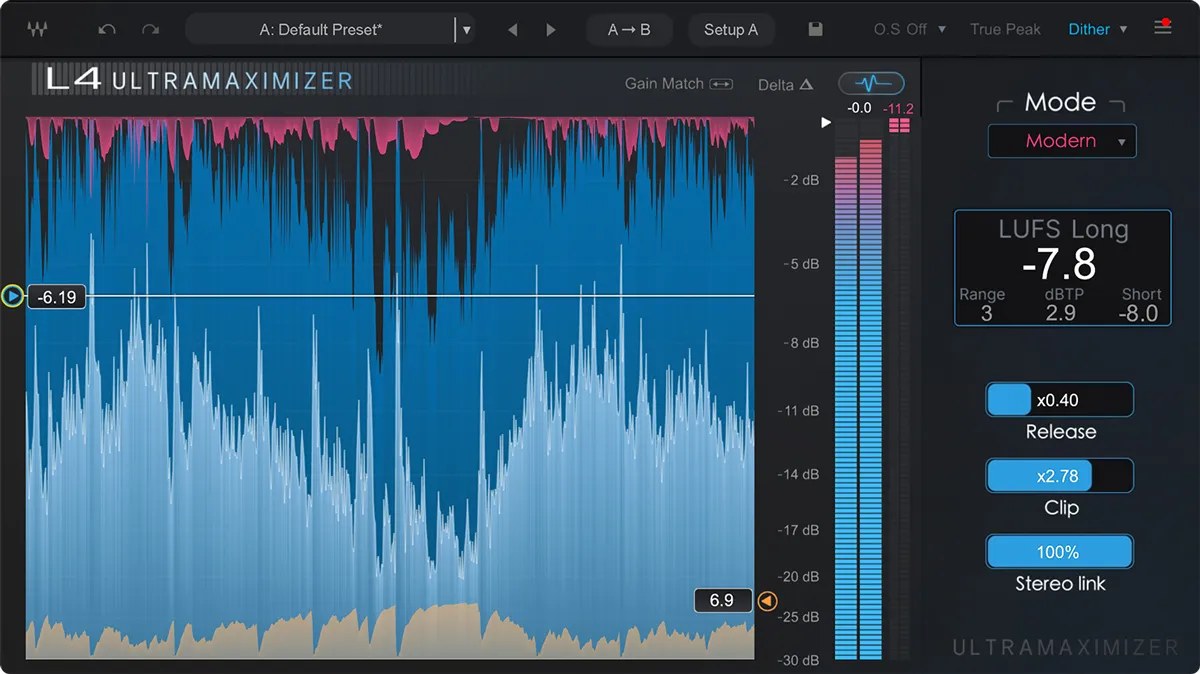
Image: Waves Audio Ltd. (from the Plugin Boutique product page)
Have you ever uploaded your own beat to SoundCloud or Spotify and thought, "somehow it lacks loudness compared to other tracks," or "even when you turn the volume up, it sounds thin and lacks impact"?
When you try to push the loudness by lowering the threshold on your maximizer, this time the kick gets crushed into a flat, clicky mess, or the audio starts to distort. A great many beat makers are stuck in exactly this endless loop.
Mixdown and mastering are common weak points for many beatmakers, and plenty of producers have no background in professional engineering. That is exactly why the excellent features of plugins matter so much at the final stage of mastering.
For years, the go-to Waves plugin for gaining loudness was the "L2 Ultramaximizer." However, since adopting the Waves L4 Ultramaximizer, the latest version in the L series released in September 2025, even producers who struggle with mastering can dial in ideal loudness in an instant. Here is an editorial breakdown, along with how to use it.
The groundbreaking features that get loudness instantly, even if you struggle with it
Why did conventional limiters rob your track of impact whenever you raised the loudness? The reason is simple: the limiter was crushing down on the "parts where you feel the most punch," namely the head of the kick and the attack of the snare (the transients).
L4 turned out to be exactly the plugin that grants the selfish wish of "wanting solid loudness without killing the groove and impact of the beat, even when you lack the knowledge and find fine-tuning difficult." The official tagline says it all: "Get loudness AND dynamics." Two points stand out in particular.
1. The "Aggressive mode" that keeps the kick intact even as you push loudness
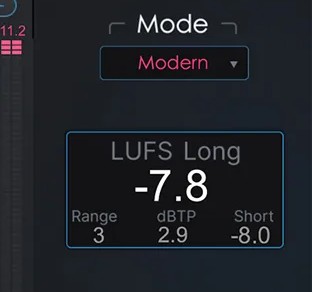
Unlike L1/L2, which used a single fixed algorithm, L4 packs in five limiting modes (Modern / Smooth / Aggressive / Safe / L2 Legacy). The interesting part is that it even includes "L2 Legacy," which reproduces the behavior of the L2.
For anyone who wants to squeeze out loudness to the absolute limit, the "Aggressive mode" is the one to try. Officially described as a mode for "loud, in-your-face sound aimed at gritty, hard-hitting mixes," to the ear it adds a pleasant sense of drive (a saturation-like texture from adaptive clipping).
With conventional limiters, the more you raised the loudness, the more the kick attack got crushed into a clicky mess. This mode, however, lets you finish the whole beat loud and hard for drill, trap, EDM, and more while "preserving" the sharp punch of the kick and the momentum of the 808 bass low end. Since you just pick a mode, no tricky fine adjustments are needed.
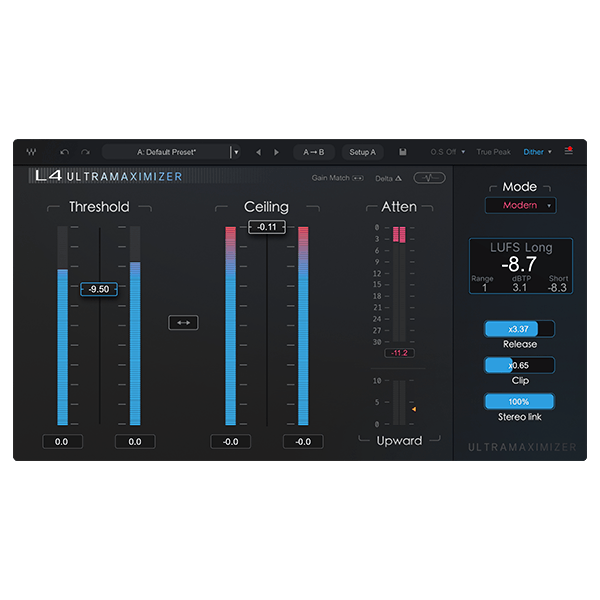
2. "Upward Compression" lifts quiet sounds from below to build a wall
L4's greatest weapon, and its most impressive addition, is the addition of the "Upward Compression" fader. According to Waves, it is a feature inspired by "MV2," the hugely famous plugin known for vocal processing and more (this does not mean the MV2 algorithm itself was ported over).
A normal limiter "crushes loud sounds from the top" to close the gaps, but L4's upward compression can "naturally lift quiet sounds from below." The official manual also explains that it lets you "fill in low-level parts without pushing the whole mix hard into the limiter."
By pushing forward the sounds sitting in the gaps of a beat, such as the tail of the top-line elements, the air of the hi-hats, and the sustain of the 808 bass, it creates an overwhelming, packed-to-the-brim loudness like a "wall of sound." Because it doesn't forcibly slam everything down from above, the dynamics stay alive, and as a result you can create a big sound with no breakdowns.
Beyond this, it includes an adaptive engine that auto-adjusts release and clipping to fit the track, a True Peak mode that meets streaming standards, an EBU R128 / ITU-R BS.1770-compliant LUFS loudness meter, gain matching, and a Delta (Δ) monitor that lets you hear only the processing component: everything you need for the final stage is here.
Leaning on plugins precisely because mastering is hard: the "Ozone + L4" routing
For anyone thinking "I've tried all sorts of things but I still can't get loudness I'm happy with," here is a routing the editorial team recommends and that many producers rely on these days.
It is this: "do all the processing except the maximizer in iZotope Ozone, then insert L4 for the very last touch (the final stage)."
- Balance the whole thing with Ozone: Even if you're weak at mastering, Ozone's AI Assistant feature can remove low-end mud and automatically clean up the tonal balance of the entire beat for you.
- The final push with L4: Without using the maximizer inside Ozone (or keeping it very light), lower the threshold on the L4 you placed at the final stage to raise the loudness, and at the same time nudge up the Upward Compression fader to add the impact of density.
*Of course, depending on the track, there are times when you want a little "texture seasoning" at the end. Some producers lightly insert texture-control plugins, such as a saturator like Softube's "Tape," to fine-tune according to the character and groove of the beat; but as a rule, the seasoning-type plugins go before L4. If L4 is handling True Peak processing or dithering, adding any processing that touches volume or tone after it would ruin the carefully managed peaks. The foundation for building the base loudness is entirely this "Ozone + L4."
Clean up the tone with Ozone's smart automatic correction, then add the "Aggressive push" and "lift from below" that Waves L4 offers as the final touch. With this combination, even producers who struggle with mastering can obtain convincing loudness that doesn't get buried in a streaming environment. To check the loudness of your finished track, try our site's Loudness Analyzer tool as well.
Price & bundle info
| Retailer | List price | Sale price |
|---|---|---|
| Plugin Boutique (Japan, in yen) | ¥17,250 | ¥7,106 (58% OFF) |
| Waves official (waves.com) | $99 | Around $35–$40 (varies by sale) |
*Prices as of July 5, 2026. Waves runs sales almost year-round, so the "on-sale street price" is effectively the going rate. The list price is displayed differently from store to store.
- Bundle inclusion: Included in Mercury and higher-tier bundles aimed at live use (such as Live Plus), as well as the Waves Creative Access subscription (Ultimate). It is not included in Horizon or Platinum (as of July 2026).
- Note: The L1 / L2 Ultramaximizer and L3 Multimaximizer remain on sale. L4 is not a replacement for them but is positioned as the newest option.
Frequently asked questions
Q1. How is L4 different from L2 or L3?
L4 is the latest model in the L series, released in September 2025. It features five limiting modes (Modern / Smooth / Aggressive / Safe / L2 Legacy), MV2-inspired upward compression, a True Peak mode, and a LUFS-capable loudness meter. L1, L2, and L3 remain on sale, but where L1/L2 use a single fixed algorithm, L4 runs on an adaptive engine. Note that L3's full name is L3 Multimaximizer (a multiband design).
Q2. Can I use it alongside iZotope Ozone?
Yes, and it is actually a great pairing. The standard approach is to shape the tonal balance and tone with Ozone, turn the Maximizer inside Ozone off (or keep it light), and place L4 at the final stage of the chain to drive loudness. As a rule, do not add any further processing after L4, since that stage handles dithering and True Peak processing.
Q3. Which bundles include L4?
As of July 2026, it is included in the higher-tier bundles such as Mercury and in the Waves Creative Access subscription (Ultimate tier). It is not included in Horizon or Platinum, so owners of those bundles will realistically want to buy it as a single product (around 7,000 yen during a sale).
Q4. Are there settings for streaming delivery?
Yes. Because L4 can tame inter-sample peaks in True Peak mode, it can meet the roughly -1.0 dBTP ceiling recommended by services such as Spotify and Apple Music. It also has a built-in loudness meter compliant with EBU R128 / ITU-R BS.1770 (Integrated / Short-Term LUFS, LRA, dBTP), so you can complete your streaming loudness checks entirely within the plugin.
Summary: the plugin that adds the "last bit of loudness" your beat is missing
The Waves L4 Ultramaximizer feels less like a mere update and more like a plugin that makes it easy to create "overwhelming loudness with no breakdowns," the very thing today's beat makers want most.
- You struggle with mixing or mastering and can't get loudness up
- You want to make tracks with more solid, substantial loudness
- You want to easily use an MV2-style "lift from below" on the master
If even one of these applies to you, L4 is without a doubt worth adopting. To take the quality of your beats up another level, be sure to check it out.
You can buy it from the Plugin Boutique product page. If you access it from Japan, it will display in yen at the sale price.