SP-404MKII vs MPC Sample vs EP-133 K.O. II: Which to Buy? (2026)
If you're shopping for a compact sampler that makes beats without a computer, the 2026 shortlist effectively comes down to three machines: the lo-fi scene's staple Roland SP-404MKII, the brand-new AKAI Professional MPC Sample (launched March 2026), and the calculator-styled hit Teenage Engineering EP-133 K.O. II.
All three are standalone units in roughly the $300–$450 street-price class, and the "which one is right" debate never stops on social media. And 2026 is the year the landscape actually shifted: the MPC Sample arrived, and the EP-133 doubled its sample memory to 128MB. Conclusions from older reviews no longer hold.
Based on each maker's official information and authorized-retailer listings as of July 20, 2026, this article compares the three on four axes — (1) lo-fi character, (2) portability, (3) beginner-friendliness, (4) expandability — and gives a verdict by user type.
Verdict first: the one-minute decision table
If you're short on time, here's the conclusion up front.
| Your type | The one to buy | Why |
|---|---|---|
| You want lo-fi, beat-tape texture / you'll also perform live | Roland SP-404MKII | Vinyl Simulator, Cassette Simulator, Lo-fi and other texture effects are built in. Its standing in the lo-fi scene is in a class of its own |
| You want MPC-style chopping and pad drumming, finished anywhere | AKAI MPC Sample | Classic MPC sequencer plus built-in battery, speaker and mic. About 5 hours per charge |
| You want the most casual, intuitive way into sampling | TE EP-133 K.O. II | Gadget-like UI with a fader and big pads. At 16mm thin, it slides into any bag for everyday carry |
| Budget first (US street prices) | EP-133 K.O. II | Around $329 at launch pricing tiers — the cheapest entry of the three (SP-404MKII streets around $449–$499, MPC Sample $399; as of July 2026) |
*Prices and specs based on official information from Roland, Akai Professional and teenage engineering, plus retailer listings (checked July 2026).
▶ Official SP-404MKII introduction (RolandChannel). A good feel for the SP-side workflow.
1. The three characters at a glance
SP-404MKII = the "texture and performance" sampler
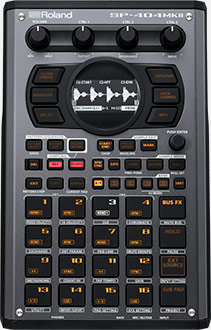
Released in 2021, it's still front and center thanks to firmware updates running through v5.5. With 41 multi-effects (Vinyl Simulator, Cassette Simulator, Lo-fi, Resonator, sidechain compression and more) triggered straight from the pads, it's the strongest of the three at "making sound dirty in a beautiful way." It adds OLED waveform editing, SKIP BACK SAMPLING (recover up to the last 40 seconds), a DJ mode, and native Serato and Koala Sampler integration. For a full review, see our "SP-404MKII review."
MPC Sample = the "MPC origin story," distilled to $399
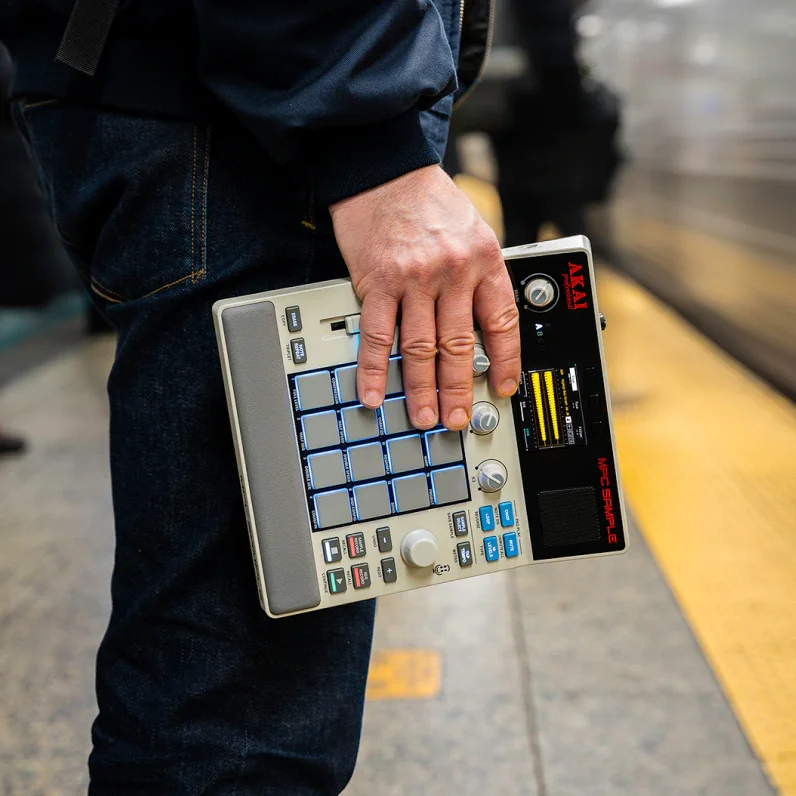
Launched March 2026, this is the newest of the three. It condenses the pad-and-chop workflow that runs from the MPC60/3000 into a sampling-focused compact machine, dropping the touchscreen and expansion plugin instruments of its bigger siblings. You get 16 velocity- and aftertouch-sensitive RGB pads, an Instant Sample Chop mode, real-time timestretch and repitch, four FX engines — plus a built-in lithium-ion battery (about 5 hours), speaker and mic. No other unit here is this complete for "walk out with just the box, record on the spot, build on the spot." More in our "MPC Sample review."
EP-133 K.O. II = the serious sampler that plays like a toy
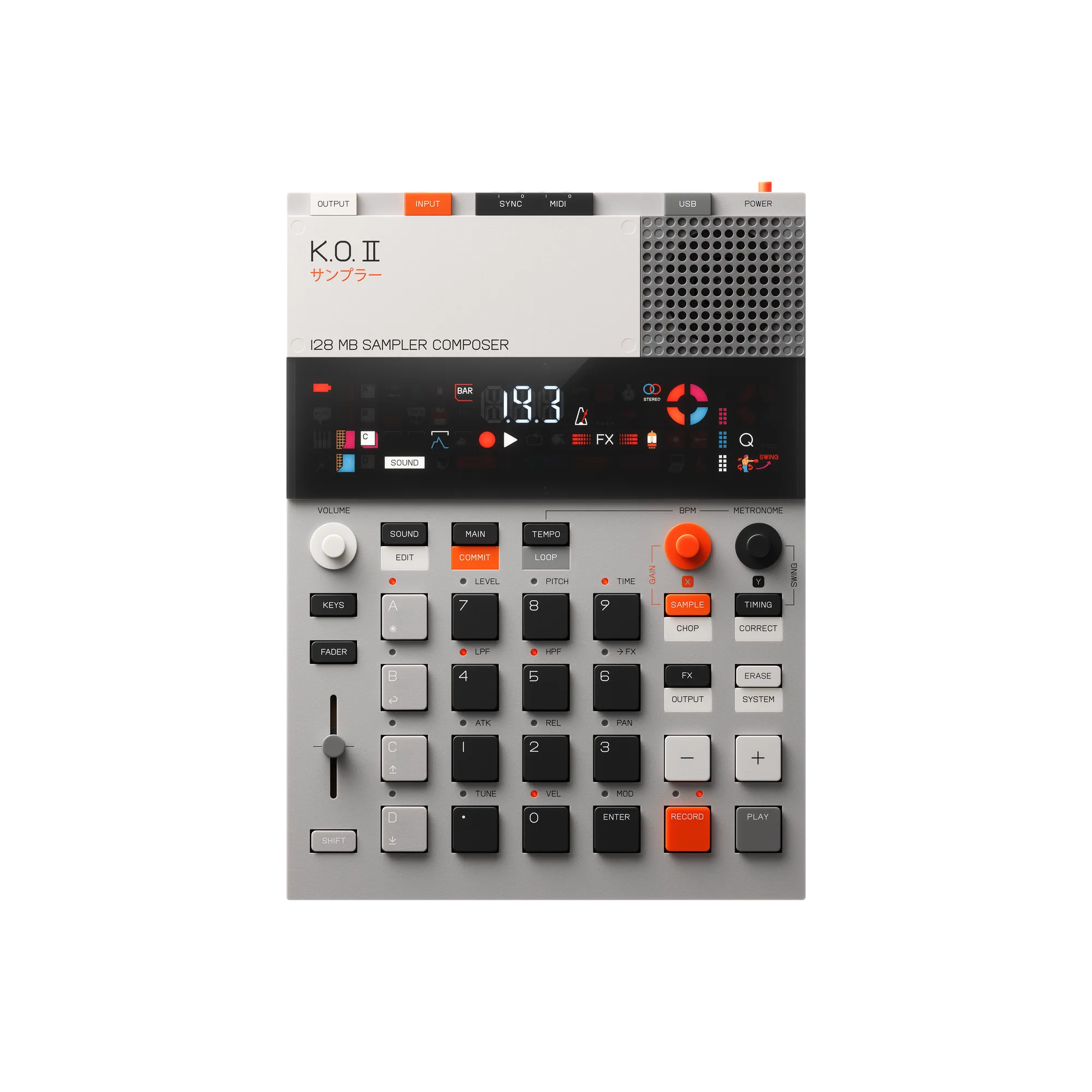
Teenage engineering's hit successor to the PO-33 K.O!. In 2026 it quietly switched to a new version with 128MB of sample memory — double the original — at the same price. Pressure-sensitive keys, a multifunctional fader, punch-in FX, built-in mic and speaker, all in a 16mm-thin slab. OS 2.5 added USB audio recording, reverse playback and more. Under the playful looks, it's a real instrument. Full review: "EP-133 K.O. II review."
2. Specs and price comparison (as of July 2026)
| Item | Roland SP-404MKII | AKAI MPC Sample | TE EP-133 K.O. II |
|---|---|---|---|
| Released | 2021 (updates through v5.5x) | March 2026 | Nov 2023 / 128MB version in 2026 |
| Price guide | $449–$499 US street (July 2026); approx. 49,500 yen incl. tax in Japan | $399 US (March 2026 launch); 62,800 yen incl. tax in Japan | Around $329 US; 55,000 yen incl. tax in Japan (July 2026) |
| Pads / keys | 16 velocity pads + 1 sub pad | 16 velocity + aftertouch RGB MPC pads | 12 pressure-sensitive keys × 4 groups |
| Storage / memory | 16GB internal + SD card | 8GB internal (approx. 2GB factory content) + microSD | 128MB sample memory (999 slots) |
| Polyphony | 32 voices | See official specs | 12 stereo / 16 mono voices |
| Effects | 41 multi-FX + 17 input FX (Vinyl / Cassette / Lo-fi etc.) | 4 FX engines | 6 master FX + 12 punch-in FX |
| Speaker / mic | None (mic/guitar input) | Both built in (3W speaker) | Both built in |
| Power | AC adaptor / USB-C / 6x AA (approx. 2.5h on alkaline) | Built-in Li-ion battery (approx. 5h, USB charging) | 4x AAA / USB-C |
| Size / weight | 178 × 276 × 71 mm, 1.1 kg | Compact, designed for backpack carry | 240 × 176 × 16 mm |
| PC / external integration | USB-C audio/MIDI, editor app (AU/VST3), Serato and Koala integration | USB-C, data via microSD | USB-C (audio recording), sync and MIDI I/O |
*Specs from the official Roland, Akai Professional and teenage engineering sites; Japanese prices from Sound House, the authorized distributor Media Integration, and inMusic Japan's announced market price (all checked July 20, 2026). Prices move, so check the store page for the latest.
3. Comparison 1: lo-fi and texture
If you're after the worn-tape texture of lo-fi hip hop and boom bap, the SP-404MKII is a clear head above. Vinyl Simulator, Cassette Simulator and the Lo-fi effect are synonymous with the SP series — the way these effects color sound has literally become part of the genre. Sidechain compression and stackable Bus FX give it the deepest sound-design well of the three.
The MPC Sample and EP-133 have effects too, but not this many, and not this texture-focused. Flip it around: if you enjoy the "chop the source, build the beat" stage more than effect sculpting, pick based on the next axes instead. To brush up the craft itself, see "how to make boom bap."
4. Comparison 2: portability and making beats outside
- MPC Sample: rechargeable Li-ion battery (about 5 hours) plus a speaker and mic means zero cables, zero outlets, start to finish. The most complete "beats anywhere" experience here.
- EP-133 K.O. II: 16mm thin, it disappears into a bag. Runs on four AAA batteries, speaker and mic on board. Ideal for sketching on the move.
- SP-404MKII: at 1.1 kg it's the heaviest, with no speaker. It does run on AA batteries or a power bank, and the rugged build suits outdoor sets. Portable, yes — but its personality is more "desktop that travels."
5. Comparison 3: beginner-friendliness
For first-time sampler owners, the real wall isn't the feature count — it's how visible the workflow is.
- EP-133 K.O. II: record, place on a pad, play, shape with the fader — the flow is readable from the faceplate itself. The shortest route to your first finished track.
- MPC Sample: built around "don't let them get lost" features like Instant Sample Chop, it teaches the direct-lineage MPC workflow in its smallest form. That muscle memory carries straight over if you upgrade to an MPC One G2 or similar later.
- SP-404MKII: its depth assumes you'll memorize shortcuts, giving it the steepest learning curve of the three. In exchange, the community and tutorial ecosystem is enormous — if learning by looking things up doesn't bother you, it's a non-issue.
6. Comparison 4: expandability and longevity
This one is the SP-404MKII's home turf. 16GB of internal storage plus SD cards, a Mac/Windows editor app that also runs as an AU/VST3 plugin, native Serato DJ / Serato Studio and Koala Sampler integration, and a DJ mode — it's built to change roles from production to DJing to live sets and stay useful for years. Nearly five years of major firmware updates since launch back that up.
The MPC Sample expands via microSD and works as a doorway into AKAI's wider MPC ecosystem. The EP-133, with its 128MB of sample memory (2026 version), is deliberately constrained — treat it as a tool you play to the edges of. Constraints cut both ways: they limit you, and they get tracks finished fast.
7. Verdict: recommendations by type
Who the SP-404MKII suits
- You want to sculpt lo-fi, beat-tape textures entirely on hardware
- You want your sampler on stage and in DJ sets too
- You want one unit to grow with (updates, integrations, community)
Who the MPC Sample suits
- You want MPC-style chopping and pad drumming finished anywhere, even off-grid
- You'd rather have focus on sampling than touchscreens and feature sprawl
- You want to build fundamentals that transfer to bigger MPCs or a DAW later
Who the EP-133 K.O. II suits
- You want the most casual entry — a device you'll actually pick up every day
- Sketching while commuting or traveling will be the core of your workflow
- Design and the sheer fun of the object matter to you when choosing gear
Any of the three delivers "sampling to finished beat, no computer." The fork in the road is texture (SP), self-containment (MPC Sample), or ease (EP-133). Picture the moment your production most often stalls, and buy the machine that removes it. Want to zoom out to pad workstations in general? See our "Maschine vs MPC comparison."
Frequently asked questions
Q1. Which is best for making lo-fi hip hop?
The SP-404MKII. It has the effects that define the beat-tape sound built in — Vinyl Simulator, Cassette Simulator, Lo-fi and more — and its track record in the lo-fi scene is unmatched. It is also on the cheaper end of the three at street prices (around $449-$499 in the US as of July 2026).
Q2. Can all three be used without a computer?
Yes. All three are standalone samplers that go from sampling to sequencing on the unit alone. The MPC Sample and EP-133 K.O. II have a built-in speaker and mic; for power, the SP-404MKII runs on six AA batteries or a mobile battery, the EP-133 on four AAA batteries or USB-C, and the MPC Sample on a built-in rechargeable lithium-ion battery lasting about 5 hours (official info as of July 2026).
Q3. How is the MPC Sample different from a regular MPC?
The MPC Sample is a compact machine focused purely on sampling. It keeps 16 velocity-sensitive MPC pads and a classic MPC-style sequencer, but drops the touchscreen and expansion plugin instruments of the higher-end models. In exchange it builds in a battery, speaker and mic, and keeps the price down to $399 (US, at its March 2026 launch).
Q4. Which should a complete beginner buy first?
For sheer ease of use, the EP-133 K.O. II is the strongest pick. Its gadget-like UI built around big pads and a fader teaches the sampling-to-song flow naturally. If you are planning to step up to MPCs or a DAW later, choose the MPC Sample; if you lean toward lo-fi textures or live performance, choose the SP-404MKII.
Summary
The 2026 compact-sampler debate is a three-way split: texture (SP-404MKII), self-containment (MPC Sample), ease (EP-133 K.O. II) — and whichever you choose, a computer-free beatmaking rig lands in the $300–$450 class. If you're still torn, scroll back to the decision table and answer honestly about how you actually work. After that, all that's left is to make beats and put them out. For checking sample BPM and key, use our free BPM/key detection tool.