Scaler EQ Review: How Is a Key-Aware EQ Different From a Regular EQ? Price & Where It Helps Your 808s (2026)
For as long as EQ has existed, it has been a tool you think about in frequencies. Scaler Music's Scaler EQ challenges that habit with a whole new category: an EQ you think about in keys and scales. It comes from the team behind the chord-progression staple Scaler 3, is billed by the developer as "the world's first truly musical EQ", holds a US patent on its core mechanism, and won a Computer Music Innovation Award in 2024.
In this article, the Beat Lab editorial team reviewed the official Scaler Music website and the Plugin Boutique product page as of July 20, 2026, and breaks down how Scaler EQ differs from a conventional EQ, where it actually helps with 808s, bass and sample processing, plus pricing and how to try it. We've also built a "when a key-aware EQ helps" cheat sheet so you can judge whether it has a place in your own workflow.
What is Scaler EQ? Music theory meets EQ
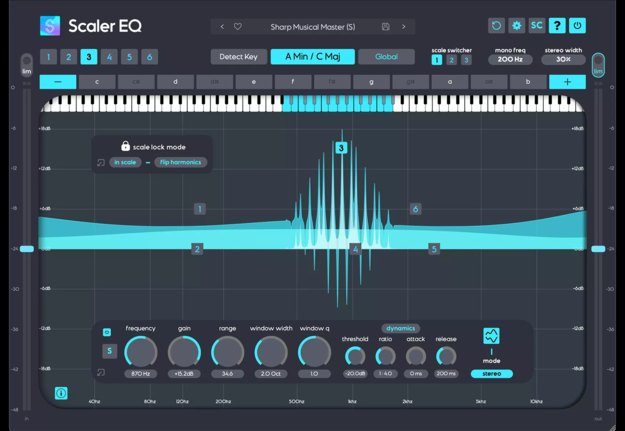
Scaler EQ is an EQ plugin developed by Scaler Music and sold through Plugin Boutique (released October 2023, with 1.x updates still ongoing). Its defining feature is that its bands understand note names and scales, not just frequencies. Set your song's key (or auto-detect it from audio or MIDI), and the patented Harmonic Peak and Plus-Minus bands perform, with a single knob, what used to be tedious work on a regular EQ: boost only the frequencies of in-scale pitches, or cut only the out-of-scale ones.
It is essentially the Scaler philosophy — "build chords without knowing theory" — carried over into mixing. If the songwriting side interests you, our Scaler 3 review (price, new features and free trial) covers the flagship in depth.
How it differs from a regular EQ
On a normal EQ, removing "off-key mud" means staring at a spectrum analyzer, hunting down fundamentals and overtones, and placing notch filters one at a time. Scaler EQ automates that workflow from the music-theory side.
- Harmonic Peak / Plus-Minus bands (patented): boosting lifts only the in-key pitch content; cutting removes only the out-of-key content (you can also invert it to cut in-key material)
- Key detection: feed it audio or MIDI and it picks up the song's key automatically. You can also look up a reference track's key with our free BPM & key detection tool and set it manually
- Add or remove scale notes: tweak the suggested scale note by note to widen or narrow how far the processing reaches
- Scale Switcher: for songs with key changes, store multiple keys/scales and switch per section (automatable)
Crucially, it also covers everything you expect from a conventional EQ: bell, shelf and high/low-pass bands, per-band dynamic mode (threshold/ratio/attack/release with sidechain input), M/S processing, and zero-latency minimum-phase operation. That makes a hybrid approach practical — musical bands where key-awareness pays off, regular bands everywhere else.
When a key-aware EQ helps: the cheat sheet
The real question is: "Sounds clever, but will I actually use it in my beats?" Based on the official feature lists, here is how the traditional-EQ approach compares with the Scaler EQ approach, scenario by scenario.
| Scenario | With a traditional EQ | With Scaler EQ |
|---|---|---|
| Cleaning up 808s / sub bass | Hunt fundamentals and overtones on an analyzer, hand-place notches on off-key resonances | Set the key and cut only the out-of-key content — lows get tidied without touching the fundamental or its harmonics |
| Cleaning sample loops | Find clashing content by ear and stack multiple notches; some of it never comes out | Reduce out-of-scale pitch content in one move — pull a 2-mix sample toward your song's key |
| Sweetening melodies & vocals | Search for the "sweet spot" by ear and boost, sometimes lifting ugly peaks with it | Boost only in-key pitches for a "tuned" sweetening effect |
| Songs with key changes | Duplicate EQs per section or write fiddly automation | Register keys in the Scale Switcher and switch (automatable) — no rebuilding the EQ |
| Pitching noise & ambience | An advanced trick involving samplers and filter banks | Scale-locked resonator presets turn rain and other noise into pitched, musical material |
| Finishing a master | Chain an EQ, M/S tool, stereo imager and limiter | Magic Shelf (M/S-linked shelving), stereo width, bass mono-ing and in/out limiting in one plugin |
*Compiled by the Beat Lab editorial team from the feature descriptions on the official Scaler Music website and the Plugin Boutique product page (confirmed July 20, 2026). If you quote or share this table, please link back to this page.
A closer look at 808 and bass duty
Low-end work is where it fits hip hop and trap production best. An 808 is meant to be tuned to your key in the first place, so Scaler EQ's behavior — keep the in-key fundamental and harmonics, remove only the stray resonances — matches the textbook approach to low-end cleanup exactly. For the fundamentals of kick separation and tuning, read it alongside our guide on how to mix 808s and bass.
One caveat: Scaler EQ is not a pitch-correction tool. It cannot "fix" an out-of-tune 808. Tune the pitch in your sampler, then let Scaler EQ handle mud removal and sweetening — that division of labor is the right one. Also, on near-atonal percussion or very dense material the key-aware bands have little to grab onto, in which case you simply fall back to its conventional bands.
Pricing and system requirements (as of July 20, 2026)
| Edition | Price | Notes |
|---|---|---|
| Scaler EQ (one-time purchase) | $59 regular | Confirmed on the Plugin Boutique product page |
| Installment plan | $4.99 x12 months | Plugin Boutique subscription-style plan (about $60 total) |
| Free trial | Free | Available from the account page on the official Scaler Music website |
*Confirmed by our editorial team on July 20, 2026 on the official Scaler Music website and the Plugin Boutique product page. Sale discounts appear regularly, so check the linked page for the current price. Plugin Boutique also offers bundles with Scaler 3.
System requirements are macOS 10.14+ (native Apple Silicon support) / Windows 7+, in VST/VST3/AU/AAX formats plus standalone. It supports major DAWs including Ableton Live, Logic Pro, FL Studio, Cubase, Pro Tools and Reaper, and ships with several hundred presets for mastering, individual instruments and sound design. The iPad version is sold separately.
Who it's for / who can wait
- You build beats around 808s and samples: low-end cleanup and sample de-mudding are chores that recur in every session, and this speeds both up. Its most obvious wins are also its easiest entry points
- You never quite know where to cut: set the key and the candidates for cutting are decided musically, which means far less time squinting at an analyzer
- You already use Scaler 3: start the song from Scaler's key setting, then mix against the same key reference — a consistent workflow across writing and mixing. See our Scaler 3 review as well
- You're still new to regular EQ moves: build fundamentals with free tools first. Our roundup of 8 recommended free plugins covers free EQs to learn on, and if writing from chords is new to you, the free chord progression generator (chordlab) is the quickest way in
If you use it on the master bus, run your bounce through our free dynamics analysis afterwards to sanity-check loudness and how hard you're pushing the limiter.
Frequently asked questions
Q1. How is it different from a regular EQ?
A. A regular EQ decides where to cut in Hz. Scaler EQ, once you set a key and scale, automatically boosts only in-scale pitch content or cuts only out-of-scale content. It also includes conventional bands, dynamic EQ and M/S processing, so it doubles as a normal EQ.
Q2. Can it fix an out-of-tune 808?
A. No. It is not pitch correction — it processes the frequency ranges that correspond to pitches. Tune the 808 in your sampler and use Scaler EQ for cleanup.
Q3. Can I try it for free?
A. Yes — a free trial is available from the account page on the official Scaler Music website (confirmed July 2026). Purchase is via Plugin Boutique: $59 one-time, or $4.99 x12 months.
Q4. Which DAWs and systems does it support?
A. macOS 10.14+ (native Apple Silicon) / Windows 7+, VST/VST3/AU/AAX plus standalone. It runs in all major DAWs, and being zero-latency it works while tracking too. The iPad version is sold separately.
Verdict
Scaler EQ is genuinely a new category of plugin: it takes "music theory times EQ" and automates low-end cleanup, sample de-mudding and sweetening on a note-name basis. At $59 regular it holds up even judged purely as a full-featured EQ, and if 808s and samples are your daily material, the investment pays itself back quickly. Start with the free trial and hear how much tidier your low end gets.