Decimort 2 Review: The Go-To Bit Crusher for That Fat 12-Bit Boom-Bap Sound
You chop your samples and program your beat, but it still doesn't hit like those hard, fat 90s drums on record — every boom-bap producer runs into this wall. The reason is simple: those beats went through 12-bit-era samplers like the SP-1200 and MPC60. The low bit depth, low sample rate, and the quirks of the conversion circuits are what created that grit and punch.
D16 Group's "Decimort 2" emulates that entire conversion circuit. More than a simple bit crusher, it's a specialist tool that recreates the whole AD/DA path of vintage samplers, and it has become a staple among hip-hop producers. In this article, the Beat Lab editorial team checked D16 official and Plugin Boutique information as of July 21, 2026, and lays out how it works, practical settings, how it differs from RC-20 Retro Color, and pricing. For the full beatmaking workflow, see how to make boom-bap beats too.
What is "Decimort 2"?
Decimort 2 is a premium bit crusher / vintage sampler emulator from D16 Group, the Polish developer known for PunchBox and Phoscyon. Their official tagline is "The highest quality low-quality effect" — an apparent oxymoron that captures exactly what this plugin is.
The character of early Akai and E-MU samplers — the coloration that made samples sound "fat" and sit well in a mix — came from their encoding techniques, low sample rates and bit depths, and conversion circuits. Decimort 2 simulates the behavior of the entire (re)sampling path, so you can apply that character to any loop or bassline after the fact. It has zero internal aliasing (no unintended digital distortion); the only "dirt" left is the modeled dirt you actually want — the decisive difference from an average bit crusher.
Five things that set it apart from "just a bit crusher"
1. Two anti-alias-style filters
A very steep low-pass (Approximation filter) coupled to the resampling frequency, plus an Images filter that controls the amount of aliasing images after resampling. You get clean control over exactly how dirty things get.
2. Adjustable jitter
A rarity among bit crushers: it introduces short-period random fluctuations to the resampling frequency, recreating the harmonic haze that comes from the instability of old circuits.
3. Two quantization algorithms
Choose between mid-riser and mid-tread quantization (bit-depth reduction), each with a drastically different dynamics response — essentially picking how the sound "crunches" to fit your material.
4. Controllable dithering
Dithering, normally a way to mask quantization errors, is opened up here as a sound-design parameter, letting you fine-tune the type of grit in your lo-fi processing.
5. Analog-like multimode filter
A resonant filter that can sit before or after the effect. The classic hardware workflow of "crush it, then smooth it with the filter" — standard practice on the SP-1200 and S950 — is complete in one plugin.
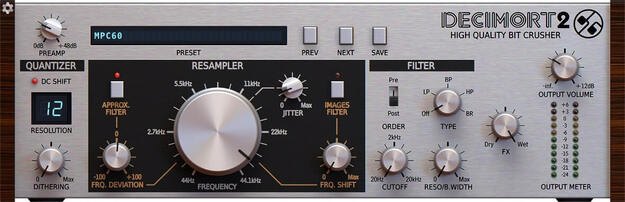
In practice: start the SP-1200 sound at "12-bit + 26 kHz"
The classic place for Decimort 2 is on material that would have gone through a sampler back in the day: drum loops and sampled melodies. Here's the editorial team's recommended entry point.
- Start from a preset: Decimort 2 ships with a generous preset library, including settings aimed at vintage sampler character in the vein of the SP-1200 and MPC60. Loading one gets you in the right ballpark instantly.
- Set the bit depth around 12-bit: as you come down from 16-bit, that "back in the day" hardness suddenly appears around 12. Both the SP-1200 and S950 are 12-bit machines.
- Set resampling to 20-30 kHz: the actual SP-1200 ran at roughly 26 kHz. That bandwidth limit is what rounds off the top end and concentrates energy in the mids — the "fatness."
- Add just a touch of jitter: too much gets murky, but a small amount adds the organic instability of old circuitry.
- Tidy up with the post filter: round off any harsh content with the low-pass, then blend with Dry/Wet so the effect doesn't take over.
A light touch on the drum bus to glue everything together is another staple, and at extreme settings it doubles as a destructive sound-design effect. If you'd rather do this workflow on hardware, a sampler like the SP-404MK2 is an alternative route.
Decimort 2 vs RC-20: a lo-fi texture plugin cheat sheet
These tools often get lumped together as "lo-fi texture plugins," but Decimort 2 and RC-20 Retro Color play clearly different roles. Here's how the editorial team breaks it down.
| What you want | Best tool | Why | Regular price |
|---|---|---|---|
| Hard, fat 90s sampler drums | Decimort 2 | Specializes in AD/DA conversion character; 12-bit + low-rate realism is in a class of its own | $59 |
| Tape/vinyl-style treatment in one go | RC-20 Retro Color | Six engines cover noise, pitch wobble, reverb and more at once | $99 |
| Quick one-stop lo-fi flavor | RC-20 (preset workflow) | Plenty of ready-to-go presets, hard to get lost | $99 |
| Deep control over bit crushing | Decimort 2 | Jitter, quantization mode, and dithering are all adjustable | $59 |
| Change the whole workflow with hardware | Hardware like the SP-404MK2 | Built-in vintage-style FX plus hands-on operation | Hardware pricing |
| Try it for free first | Your DAW's stock bit crusher | Good enough to confirm the general direction | Free |
*Regular Plugin Boutique prices as of July 21, 2026.
The conclusion is simple: if you want the sound of a sampler, get Decimort 2; if you want the sound of old playback media as well, get RC-20. Owning both is also practical — build the core character with Decimort 2, then add noise and wobble with RC-20 on top. If you'd rather start free, our recommended free plugins roundup is a useful reference.
Price and specs (as of July 21, 2026)
| Item | Details |
|---|---|
| Product | Decimort 2 (D16 Group) |
| Regular price | $59 (Plugin Boutique) / €59 (D16 official store), confirmed July 21, 2026 |
| Formats | VST2 / VST3 / AU / AAX (Mac 64-bit only, Apple Silicon supported; Windows 7 or later) |
| Type | Bit crusher / vintage sampler emulator |
| Key features | Two anti-alias-style filters, adjustable jitter, two quantization algorithms, dithering, pre/post multimode filter, MIDI Learn |
| Bundles | Included in SilverLine Collection (€399) and Total Bundle (€999) |
*Prices are as of the retrieval date. Check the sales page for the latest price and sale status.
D16 products are frequently discounted throughout the year, including Black Friday and summer sales, so waiting for a sale is a strong option if you're not in a hurry. If you already own another D16 product, crossgrade pricing is sometimes available too.
Frequently asked questions
Q1. How much does Decimort 2 cost?
The regular price is $59 on Plugin Boutique and €59 on the D16 official store (as of July 21, 2026). It goes on sale frequently, so check the sales page for the latest price.
Q2. Should I buy Decimort 2 or RC-20 Retro Color?
They play different roles. Decimort 2 is a specialist focused on the AD/DA conversion character of vintage samplers (bit depth and sample rate); RC-20 is an all-in-one treatment covering noise, pitch wobble, and reverb. If the hard, fat 90s sampler sound is your top priority, go Decimort 2; for a quick overall "aged" vibe, go RC-20.
Q3. What tracks should I use it on?
Material that could plausibly have gone through an old sampler — drum loops and sampled melodies — is the classic target. Around 12-bit with resampling at 20-30 kHz gets you that hard, gritty SP-1200-era character.
Q4. How is it different from my DAW's stock bit crusher?
Decimort 2 simulates the entire AD/DA conversion path with zero internal aliasing; the only artifacts left are the modeled, intentional ones. It also offers controls that simple bit reduction lacks, such as jitter and selectable quantization modes.
Summary: bolt "the sound of a sampler" onto your DAW
Decimort 2 lets you retrofit the source of 90s hip-hop's punch and grit — the conversion circuitry of 12-bit samplers — onto a modern DAW. Presets get you in the right direction within minutes, while jitter and quantization options give it real depth when you want to dig in. At a regular price of $59 it's affordable for a specialist tool, and since its role doesn't overlap with RC-20, the two pair well — the editorial team sees it as a high-return investment for boom-bap and lo-fi beatmakers.